
You want to learn digital marketing. You search online. You find hundreds of courses, thousands of videos, and endless advice. SEO experts say learn SEO first. Ads experts say run campaigns. Content creators say build a personal brand. Everyone has an opinion. Nobody has a clear path. No mentorship.
You feel overwhelmed. You don’t know where to start. You jump between topics. You watch a little SEO, a little social media, a little email marketing. Months pass. You’ve consumed a lot. You’ve built nothing. This is the beginner’s trap. And almost everyone falls into it.
I fell into it too. Now I mentor beginners. Here is what they actually need to learn.
| What Beginners Think They Need | What Beginners Actually Need |
|---|---|
| All the tools | One tool, deeply understood |
| Every marketing channel | One channel, proven with results |
| Advanced strategies | Fundamentals applied consistently |
| More courses | More implementation |
| A perfect plan | A messy start |
My Story
When I started learning marketing, I consumed everything. SEO videos. Google certifications. Udemy courses. Social media tutorials. I felt productive. My notes were growing. My bookmarks were full.
Then someone asked me to actually build something. A website. A simple one. I froze. All that learning. All those notes. And I couldn’t execute a basic project.
That moment taught me something courses never did. Learning without doing is useless. Knowledge without implementation is entertainment. You don’t need another course. You need a clear path, a real project, and someone to tell you when you’re on the right track.
That is what mentorship provides. That is what I try to give my students now.
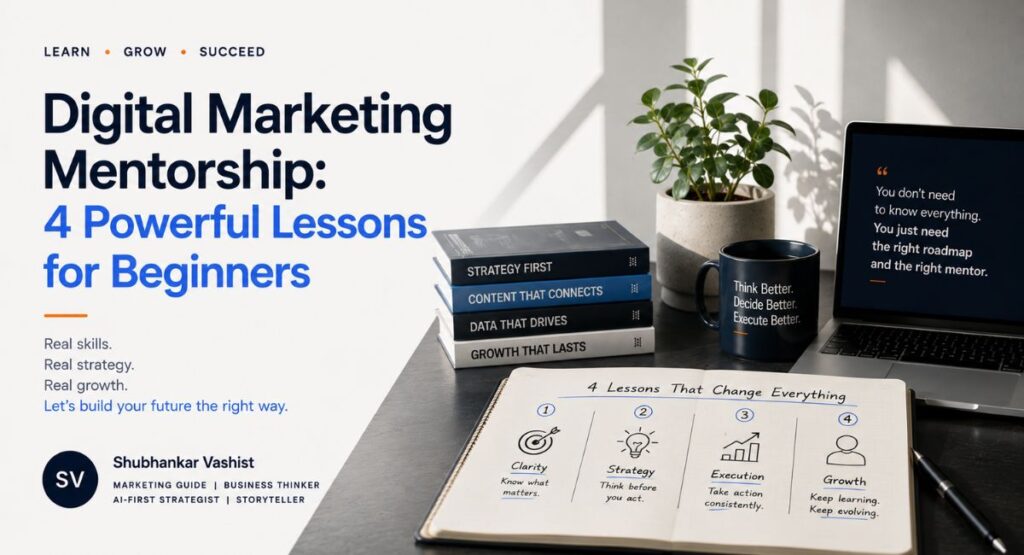
The Four Things Beginners Actually Need
Thing 1: A clear sequence, not a course catalog.
Most courses are structured like encyclopedias. Chapter one. Chapter two. Everything is covered. Nothing is prioritized. Beginners don’t need to know everything. They need to know what to learn first, what to learn second, and what to ignore completely for now.
I start my students with marketing fundamentals. Understanding the customer. Defining the audience. Mapping the journey. Then they learn AI tools. Then websites. Then content. Then ads. Then automation. Each skill builds on the previous one. The sequence matters more than the content.
Thing 2: Real projects, not fake exercises.
Watching a video about Facebook Ads is not the same as running a real campaign. Reading about SEO is not the same as ranking a real page. The only way to learn marketing is to do marketing. On real projects. With real consequences.
In my program, every week has an output. A website page. An ad campaign. A content calendar. An AI workflow. A portfolio piece. By the end, students don’t just have knowledge. They have proof of work. That proof gets them hired.
Thing 3: Feedback that unblocks you.
Beginners get stuck. That’s normal. What’s not normal is staying stuck for weeks because you have nobody to ask. A simple question. A quick review. A “yes, that’s right, now move forward.” That’s what mentorship provides.
When I was learning alone, I spent hours stuck on problems that would have taken five minutes to solve with guidance. Now I personally review every student assignment. Not to judge. To unblock. Most beginners know more than they think. They just need someone to confirm they’re on the right path.
Thing 4: Accountability that creates momentum.
A video doesn’t care if you finish it. A course doesn’t follow up if you disappear. A certification doesn’t check if you implemented anything. Without a deadline, a live session, or a person expecting your work, most people default to consumption.
Live sessions on a fixed schedule. Assignments with real deadlines. A community that notices when you’re absent. These create accountability. And accountability creates momentum. Without it, even the best curriculum fails.
What Mentorship Looks Like in Practice
Mentorship is not about holding your hand forever. It’s about giving you a clear path, showing you how to walk it, and being there when you stumble. Then you learn to walk on your own.
A good mentor doesn’t give you all the answers. They ask the right questions. They point out what you missed. They share what they learned from their own failures. They save you time because they’ve already made the mistakes you’re about to make.
I don’t teach theory I read in books. I teach what I learned from failed campaigns, wrong decisions, lost clients, and years of figuring things out the hard way. That’s what makes mentorship different from a course. It’s lived experience, not curated content.
Checklist for Choosing a Marketing Mentor
- □ Have they actually done the work, or just taught about it?
- □ Can they point to real projects and real results?
- □ Do they share their failures, or only their successes?
- □ Do they provide feedback on your work, or just give you videos?
- □ Is there a clear sequence, or is it a random collection of topics?
- □ Are there deadlines and accountability, or is it self-paced forever?
- □ Do they understand your specific background and goals?
- □ Will you build real proof of work, or just collect notes?
Things Nobody Tells You About Learning Marketing
You don’t need to learn everything. You need to learn enough to start doing. Once you start doing, the learning accelerates naturally. You encounter real problems. You find real solutions. That’s how real marketers are built.
Your first attempts will be bad. My first website was basic. My first ad campaign flopped. My first SEO attempt was messy. That’s not failure. That’s the process. The only real failure is not starting at all.
The marketing industry changes fast. Tools change. Algorithms change. Platforms rise and fall. But fundamentals don’t change. Understanding your customer. Solving real problems. Communicating clearly. Building trust. Master these, and you can adapt to any tool or platform.
Reality Check
A mentorship program won’t magically make you a successful marketer. You still have to do the work. You still have to show up. You still have to push through the discomfort of being a beginner. But the right mentorship gives you something priceless. A clear path, faster progress, and someone who believes in your potential even when you don’t.
Common Mistake
Beginners often choose mentors based on follower count. They assume popularity equals teaching ability. It doesn’t. Some of the best mentors I know have small audiences but deep expertise. They spend their time helping students, not growing their Instagram. Look for substance, not visibility.
Key Takeaway
Beginners don’t need more information. The internet is full of information. What they need is a clear sequence, real projects, personal feedback, and accountability. That’s what mentorship provides. That’s what turns a confused beginner into a confident marketer. I know because I was that confused beginner. And I know what finally made the difference.
Your Next Step Today
If you’re learning marketing right now, ask yourself: Am I just consuming, or am I building? Do I have a clear sequence, or am I jumping between topics? Do I have someone reviewing my work, or am I learning alone? Answer honestly. Then fix the biggest gap. That one change will accelerate your progress more than any course.
FAQ
Q: How is mentorship different from a regular course?
A: A course gives you information. Mentorship gives you direction, feedback, and accountability. A course doesn’t care if you finish. A mentor notices when you disappear. A course teaches theory. A mentor shares lived experience, including failures.
Q: When is the right time to seek mentorship?
A: When you’re tired of being confused. When you’ve consumed enough free content to know you’re serious. When you’re ready to stop learning and start building. Mentorship is most valuable when you have specific goals and need a clear path to reach them.
Q: How do I know if a mentor is right for me?
A: Check their background. Have they done what you want to do? Do they share failures or only wins? Do they offer feedback or just content? And most importantly, do you feel comfortable being honest about your struggles with them? Trust your instinct.