
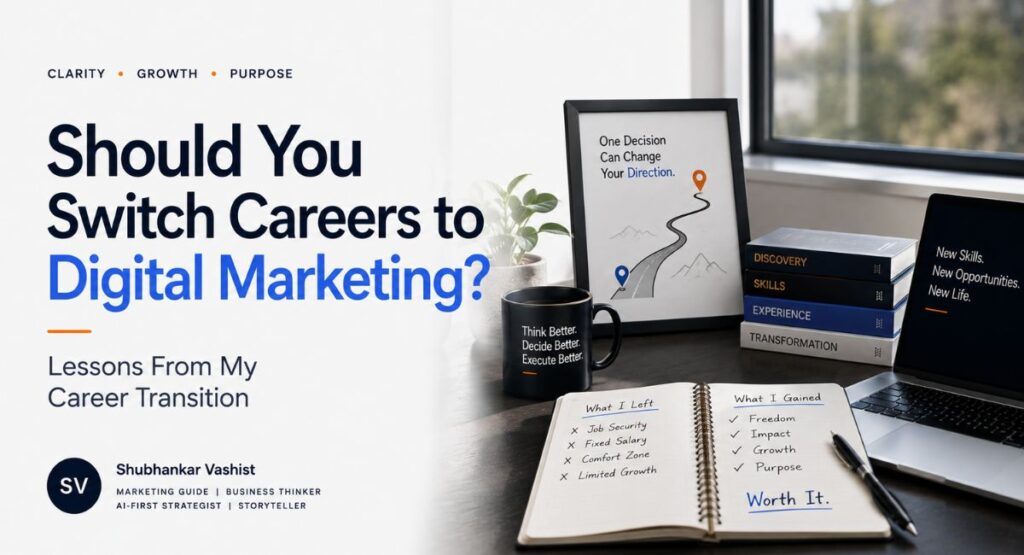
You are stuck in a career that doesn’t excite you anymore. The paycheck comes, but the purpose doesn’t. You look at digital marketing and wonder: is that the answer? Can I switch? Will it work for me?
I asked myself the same questions. Not once. Multiple times. My career path was not a straight line. It was a zigzag of wrong turns, hard lessons, and eventually, clarity. Here is what I learned.
| What People Assume | What I Discovered |
|---|---|
| You need a marketing degree | You need implementation skills |
| Switching is risky | Staying stuck is riskier |
| You must start from scratch | Your past experience is an asset |
| One right move solves everything | Career change is a series of small moves |
| You need to quit your job first | You can build skills alongside your job |
My Story
I started as a pharmacist. Yes, a pharmacist. My first role was at a pharmacy chain. Nine months later, I left because promises were broken. Then I became a prescription digitiser at a health-tech startup. Reading prescriptions, digitizing data, processing orders. Not glamorous. But it was my entry into the digital world.
Then I tried pharmaceutical sales. Field work. Meeting doctors. Multiple companies. Multiple attempts. I failed at all of them. But those failures gave me something valuable. Clarity about what I didn’t want to do.
I returned to digital operations. Then 2020 happened. I got laid off. Two months with no job. No income. No plan. But in that silence, I discovered digital marketing. YouTube. Google Digital Garage. Udemy. I taught myself websites, SEO, and eventually the full marketing stack.
Was it easy? No. Was it worth it? Absolutely. Today, I teach marketing. Not because I studied it in college. But because I lived it, failed at it, and figured it out.
Why Most Career Switchers Struggle
They assume a career switch is one big leap. It isn’t. It’s a series of small, calculated steps. The people who succeed don’t jump blindly. They build skills while they’re still employed. They test the waters before diving in. They treat the transition like a project, not a gamble.
When I was shifting from healthcare to marketing, I didn’t quit everything and hope for the best. I learned at night. I took small projects. I built a portfolio before I ever called myself a marketer. By the time I was ready, I had proof of work.
The Five Questions You Must Answer Before Switching
Question 1: Why digital marketing?
Be honest. Is it because you genuinely enjoy problem-solving, understanding audiences, and building things that convert? Or is it because someone on Instagram said it’s an easy way to make money? Your why determines whether you’ll survive the hard days. And there will be hard days.
Question 2: What skills do you already have that transfer?
Every career gives you transferable skills. Healthcare gave me attention to detail and the ability to understand complex systems. Your background, whatever it is, has value. Communication. Analysis. Writing. Psychology. Numbers. Customer understanding. Don’t discard your past. Use it.
Question 3: Can you start before you quit?
The smartest career switchers build skills on the side. Even one hour a day compounds. In six months, you can develop real competence. In a year, you can have a portfolio. Don’t quit your job and then figure it out. Figure it out, then quit if you want to.
Question 4: Are you willing to be a beginner again?
Switching careers means starting from the bottom. You might have been experienced in your old field. Respected even. In marketing, you’re new. That’s humbling. If your ego can’t handle being a beginner, the transition will break you. Mine almost did. But I learned to embrace the discomfort.
Question 5: Do you have proof, or just interest?
Interest gets ignored. Proof gets hired. Before you apply for marketing roles, have something to show. A website you built. A campaign you ran. A social account you grew. A case study you wrote. Employers don’t hire interest. They hire evidence.
My Career Transition Framework
Phase 1: Explore while employed.
Don’t quit your job on a dream. Learn marketing while you’re still earning. Use evenings. Use weekends. Take free resources seriously. I learned more from free YouTube videos than most people learn from expensive courses.
Phase 2: Build one skill deeply.
Don’t try to learn everything at once. Pick one thing. SEO. Content writing. Meta ads. Social media management. Get good at that one thing. Build something real with it. My first real project was a website for a small brand. It wasn’t impressive. But it was proof.
Phase 3: Create proof of work.
A portfolio of real projects beats any resume. Build a website. Run a small ad campaign. Write content that ranks. Offer to help a friend’s business for free or cheap. The goal is evidence, not income. Not yet.
Phase 4: Apply strategically.
Don’t spam applications. Target roles where your past experience is an advantage. Healthcare marketing needs people who understand healthcare. Ecommerce marketing needs people who understand products. Your background is not a weakness. It’s your niche.
Phase 5: Keep learning, keep building.
Your first marketing job won’t be your dream job. Mine wasn’t. But it’s a platform. Learn everything. Volunteer for cross-functional work. Sit with other teams. The fastest way to grow is to understand the whole business, not just your role.
What Nobody Tells You About Career Switching
The first few months will feel like you made a mistake. You’ll feel behind. You’ll compare yourself to people who started five years earlier. This feeling is normal. Don’t let it make you quit.
Your previous career is not wasted time. It’s your differentiator. When I teach marketing now, I bring a healthcare professional’s precision and a multi-role operator’s perspective. That combination is rare. Your combination will be rare too.
There is no perfect time to switch. There will always be a reason to wait. Wait until you have more savings. Wait until the market is better. Wait until you feel ready. But ready never comes. You start before you’re ready, and you figure it out along the way.
Reality Check
Digital marketing is not a magic solution to career dissatisfaction. It’s hard work. It’s constant learning. It’s dealing with algorithms that change, clients who don’t understand what you do, and campaigns that fail for no obvious reason. If you want easy, this isn’t it. But if you want meaningful work where you can see the direct impact of what you build, it’s worth every struggle.
Common Mistake
People think a certification will get them a job. It won’t. Certifications help. But employers care about what you can do, not what you’ve studied. I’ve seen people with no formal marketing education get hired over MBA graduates. Why? Because they had a portfolio. They had proof. Build proof. Everything else is secondary.
Key Takeaway
Switching to digital marketing is not a leap of faith. It’s a series of deliberate steps. Build skills while you’re employed. Create proof of work. Use your past experience as an advantage. And start before you feel ready. I switched from pharmacy to digital operations to marketing to teaching. None of it was planned. All of it was built one step at a time.
Your Next Step Today
If you’re considering a switch, don’t quit your job tomorrow. Instead, pick one marketing skill. Just one. Spend 30 minutes learning it today. Then spend 30 minutes applying it. Build something tiny. Do this for 30 days. At the end of the month, you’ll have more clarity than any amount of thinking could give you.
FAQ
Q: How long does it take to switch to digital marketing?
A: It depends on your starting point and effort. With consistent part-time effort, you can build enough skills for an entry-level role in three to six months. If you want to freelance, it might be faster because you can start with small projects immediately. The key is consistent output, not just consistent learning.
Q: Do I need to learn coding for digital marketing?
A: Basic HTML and CSS help, especially for landing pages and email marketing. But you don’t need to be a developer. Most tools are no-code now. Understanding how things work technically will make you better, but it’s not a requirement to start.
Q: What if I’m older than most people switching careers?
A: Age is an advantage in marketing if you use it right. Marketing is about understanding people. Life experience helps you understand audiences better than a twenty-two-year-old can. Plus, industries like healthcare, finance, and B2B marketing value maturity and domain knowledge. Your age is not a weakness. It’s a positioning tool.