
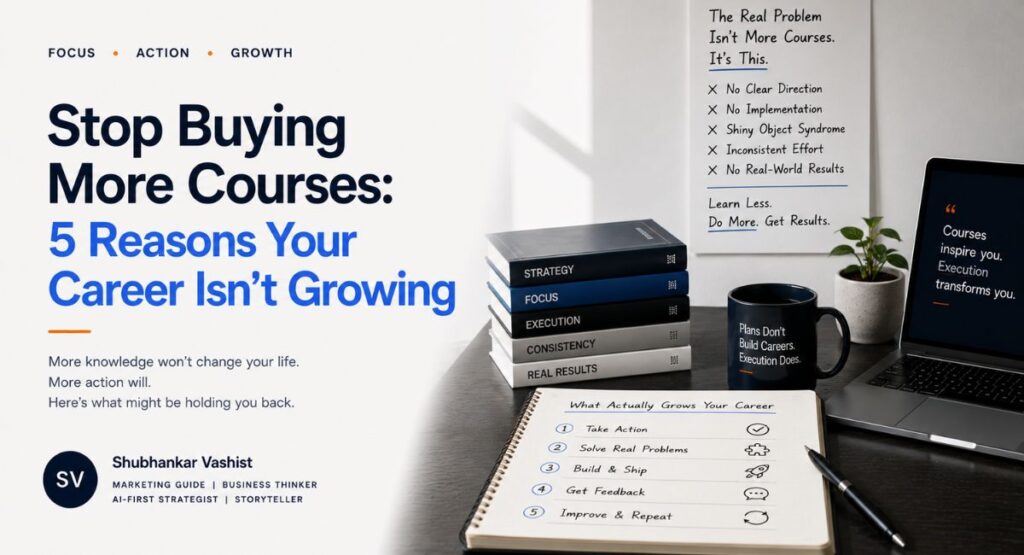
You just bought another course. It was on sale. The syllabus looked impressive. The testimonials were convincing. You felt a rush of motivation. This one will finally change things, you told yourself.
But deep down, you know the truth. Your hard drive is full of courses you never finished. Your email is full of login links you never used. Your notes are full of insights you never applied. And your career still looks the same as it did six months ago.
I know this because I lived it. And I know why you keep buying courses. It’s not because you need more information. It’s because buying feels like doing. But it isn’t.
| What Buying a Course Feels Like | What Buying a Course Actually Is |
|---|---|
| Taking action | Avoiding action |
| Investing in yourself | Paying to procrastinate |
| Gaining knowledge | Collecting PDFs |
| Making progress | Feeling productive without producing anything |
| Solving the problem | Delaying the real work |
My Story
When I started learning digital marketing, I collected courses like some people collect stamps. Udemy sales. Free webinars. YouTube playlists saved to “Watch Later.” Google certifications. I had them all. My phone storage was full. My mind was full. But my portfolio was empty.
Then 2020 happened. I got laid off. No job. No income. No safety net. Suddenly, I didn’t have the luxury of “learning” anymore. I needed to earn. And nobody pays you for courses you’ve bought. They pay you for things you’ve built.
That pressure forced me to stop buying and start building. My first website was basic. Ugly even. But it was real. My first project paid very little. But it was proof. I learned more from that one messy project than from all the courses I had collected before it.
Today, I teach a 16-week program. And the first thing I tell my students is this. If you have bought more than three courses in the last year and finished none of them, do not buy mine. Go finish what you already have. Apply it. Build something. Then come back.
Why You Keep Buying Courses
Buying a course gives you a dopamine hit. It feels like you’re doing something productive. You’re investing in yourself. You’re taking your career seriously. Your brain rewards you before you’ve even watched the first video.
But that feeling fades. A week later, the course sits unfinished. A month later, you’ve forgotten about it. Three months later, you buy another one. The cycle repeats.
This is not learning. This is collecting. And collecting doesn’t change your career. It just fills your hard drive.
The course industry knows this. That’s why they run sales every week. That’s why every launch feels urgent. “Only 48 hours left.” “Seats filling fast.” “Last chance.” They’re selling you the fantasy of transformation. But transformation doesn’t happen at checkout. It happens when you do the work.
The Hidden Cost of Course Hopping
Every course you buy but don’t finish has a cost. Not just the money. The real cost is worse.
It fragments your attention. You jump between different frameworks. Different teaching styles. Different strategies. Nothing sticks because nothing is followed through.
It creates confusion. One course says focus on SEO. Another says focus on ads. A third says build a personal brand. You try to do all three and master none.
It delays real progress. Every hour spent watching a course is an hour not spent building something real. A website. A portfolio. A campaign. Proof of work.
It erodes your confidence. Six months pass. Twelve courses purchased. Zero projects completed. You start to wonder if you’re cut out for this. You’re not the problem. The approach is.
What Actually Works Instead
Finish one thing before you buy another.
This sounds obvious. Almost nobody does it. Before you even browse another course, complete the last one you bought. Not just watch it. Complete it. Do every exercise. Build the project. Get the result. Then decide if you need more.
Apply more than you consume.
For every hour of learning, spend two hours building. Watch a video about SEO? Spend two hours optimizing a real page. Learn about ads? Launch a real campaign with a tiny budget. The ratio must favor doing over watching.
Build proof, not a course library.
Your collection of certificates doesn’t impress employers. Your collection of projects does. A portfolio of real work beats a resume full of course names. The market pays for what you can do, not what you’ve studied.
Seek feedback, not just information.
Courses give you one-way information. They don’t tell you if you’re doing it right. Find someone who will review your work. A mentor. A peer. A community. Feedback is what turns knowledge into skill.
Use free resources first.
Before you spend money, exhaust what’s free. YouTube has world-class marketing education. Google offers free certifications. Communities share knowledge openly. If you can’t learn from free resources, you won’t learn from paid ones either. The problem isn’t access. It’s action.
Checklist for Course Buyers
- □ Have you finished the last course you bought, or just watched a few videos?
- □ Have you built anything with what you learned, or just taken notes?
- □ Do you have proof of work from your learning, or just certificates?
- □ Are you buying this course to learn, or to avoid doing the hard work?
- □ Have you applied the free resources on this topic before paying for more?
- □ Do you have a mentor or peer reviewing your work, or are you learning alone?
- □ Is your portfolio growing faster than your course library?
- □ If a client asked what you can do, could you show them, or just tell them?
Things Nobody Tells You About Course Addiction
The best marketers I know didn’t learn from courses. They learned from doing. They built terrible websites. They ran failed campaigns. They made mistakes that cost money. That’s where real learning happens. Not in a video player.
Courses are not bad. I run a program myself. But courses are starting points, not finish lines. They give you a map. You still have to walk the path. Most people collect maps and never take a single step.
One well-chosen program, completed fully, with every assignment done and every project built, is worth more than fifty courses bought on sale and never opened. Depth beats breadth every time.
Reality Check
Look at your course library right now. Count how many you’ve bought. Now count how many you’ve actually finished. Now count how many led to a real project, a real result, or a real career change. If the ratio is bad, more courses won’t fix it. Only action will.
Common Mistake
Waiting for the perfect course before you start. There is no perfect course. There is no perfect curriculum. There is no perfect teacher. There is just you, the work, and whether you’re willing to do it. Stop waiting for the right program. Start with what you already have.
Key Takeaway
More courses won’t save you. More implementation will. Stop buying. Start building. Finish what you already have. Apply what you already know. The information you need is probably already sitting in your inbox. The gap isn’t knowledge. The gap is action. Close it.
Your Next Step Today
Do not buy another course this month. Instead, pick one course you’ve already purchased but never finished. Watch one module today. Then spend two hours applying what you learned. Build something real. Publish it somewhere. Do this every day for a week. At the end of the week, you’ll have more progress than the last six months of buying and hoarding.
FAQ
Q: When is it actually worth buying a course?
A: When you’ve exhausted free resources on the topic. When you’ve tried to learn it yourself and identified specific gaps. When the course offers something you can’t get for free, like personal feedback, accountability, or a structured path. And most importantly, when you’re ready to do the work, not just watch the videos.
Q: How do I break the cycle of buying courses and never finishing them?
A: Make a rule. You cannot buy a new course until you’ve finished the last one and built something with it. Public commitment helps. Tell someone your goal. Give yourself a deadline. The social pressure of accountability is powerful.
Q: What if I genuinely need structured learning?
A: Structured learning is valuable. But structure without implementation is still just entertainment. Choose one program. Commit to it fully. Attend every session. Do every assignment. Build every project. One completed program beats ten abandoned one