
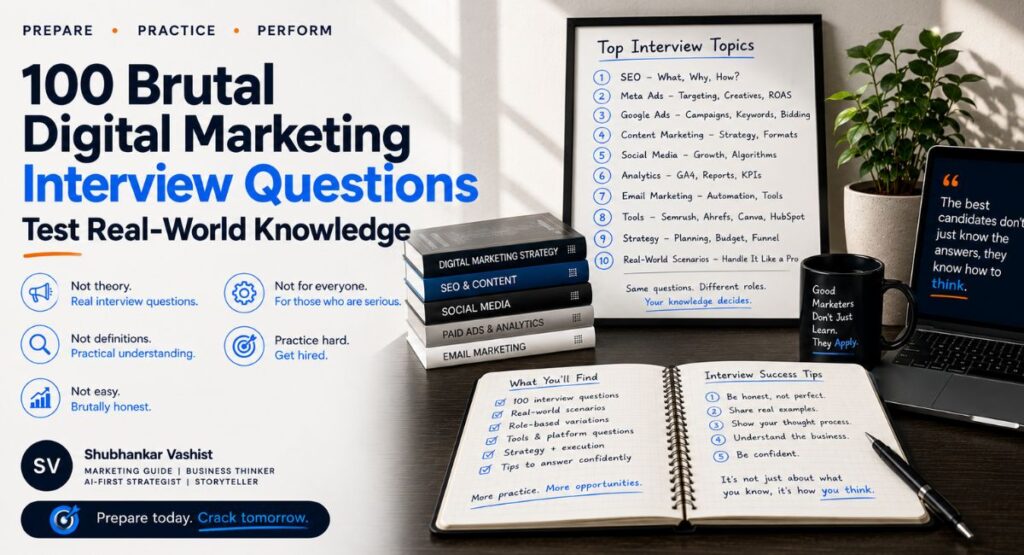
Most digital marketing interviews fail because candidates prepare for the wrong thing.
They memorize definitions. They learn tool names. They watch videos on “Top 10 Interview Questions.”
But real interviews are not about definitions. They are about thinking.
A good interviewer does not ask you “What is SEO?” They ask you “Why did your traffic increase but leads decrease?” That is a completely different question. It tests your understanding of how marketing actually works in a business.
This guide is built for that reality.
We will cover 100 difficult digital marketing interview questions. Not 100 definitions. 100 situations, problems, and decisions that real marketers face.
This is Part 1. It covers the first 25 questions. These are the questions that test whether you understand the fundamentals or have just memorized them.
Do not rush through this. Read each question. Pause. Try to answer it yourself. Then read the answer.
The goal is not to memorize. The goal is to understand.
Let’s begin.
Level 1: Fundamentals (Questions 1-15)
Question 1
What is digital marketing, and what is the biggest mistake people make when defining it?
Short Answer:
Digital marketing is using online channels to reach, engage, and convert a specific audience for a business goal. The biggest mistake is defining it as “running ads” or “posting on social media.” That is activity, not marketing. Real digital marketing starts with understanding the business problem and then choosing the right channel.
Why This Matters:
This question tests whether you see the big picture or just the tools. A weak candidate lists channels. A strong candidate talks about solving business problems.
Example:
A business says “I want to grow.” A weak marketer says “Let’s run Instagram ads.” A strong marketer asks “What does growth mean? More customers? Higher order value? Repeat purchases?” Then they decide which channel and strategy fits.
Follow-Up:
Q: What is the difference between digital marketing and performance marketing?
A: Digital marketing is the broad umbrella: SEO, content, social, email. Performance marketing is a subset focused on measurable outcomes like leads, sales, or ROAS. Every performance marketer does digital marketing, but not every digital marketer does performance marketing.
Question 2
What is the difference between a strategy and a tactic? Give an example from digital marketing.
Short Answer:
A strategy is the overall plan to achieve a business goal. A tactic is a specific action you take to execute that strategy. Strategy is the “what” and “why.” Tactic is the “how.”
Why This Matters:
Most candidates confuse the two. They list tactics like “post reels” or “run Google Ads” when asked about strategy. This question separates thinkers from doers.
Example:
Strategy: We will position ourselves as the most trusted brand for first-time home buyers. Tactic: We will create a series of educational YouTube videos answering common home loan questions and run them as ads to a retargeting audience. The tactic serves the strategy, not the other way around.
Follow-Up:
Q: Why do most businesses fail at strategy?
A: Because they jump to tactics without thinking. They see a competitor running reels and copy it. They never ask what goal those reels serve. Without a strategy, tactics are just random activity.
Question 3
What is the difference between a metric and a KPI?
Short Answer:
A metric is any measurable data point. A KPI, or Key Performance Indicator, is a metric that is directly tied to a business goal. All KPIs are metrics, but not all metrics are KPIs.
Why This Matters:
This tests whether you can prioritize. Businesses drown in data. A strong marketer knows which numbers matter and which are just noise.
Example:
Website traffic is a metric. Cost Per Acquisition is a KPI because it directly impacts profitability. Instagram followers is a metric. Conversion rate from a landing page is a KPI because it affects revenue.
Follow-Up:
Q: How do you decide which metrics to report to a client?
A: I report KPIs first: leads, sales, CPA, ROAS. Then I show supporting metrics like CTR or traffic only when they help explain why a KPI moved up or down.
Question 4
What is a marketing funnel, and why do most businesses misunderstand it?
Short Answer:
A marketing funnel is the journey a person takes from awareness to purchase. It typically has stages like awareness, consideration, conversion, and retention. Most businesses misunderstand it because they try to sell at every stage instead of giving the right message at the right time.
Why This Matters:
This tests whether you understand customer psychology. A weak marketer treats every audience the same. A strong one adjusts the message based on where the person is in the funnel.
Example:
A person seeing your brand for the first time is not ready to buy a Rs 50,000 course. They need education and trust first. A person who already visited your pricing page just needs a nudge, maybe a discount or a testimonial. The same message would fail at one of these stages.
Follow-Up:
Q: Is the funnel still relevant today?
A: Yes, but it is not linear. People jump between stages. Someone might see an ad, leave, then come back a week later through a Google search. The funnel helps you structure your message, but you should not treat it as a strict path.
Question 5
What is the difference between brand awareness and performance marketing, and can they work together?
Short Answer:
Brand awareness is about making people remember you. Performance marketing is about driving a specific action like a click, lead, or sale. They can and should work together. Strong brand awareness makes performance marketing cheaper because people are more likely to click and convert when they already trust you.
Why This Matters:
This tests whether you see marketing as one system or separate silos. A weak candidate says “I only do performance.” A strong one understands that brand and performance feed each other.
Example:
You run a YouTube ad that tells a story about your brand. It does not directly sell. Two weeks later, you run a retargeting ad to people who watched that video. The second ad converts at a much higher rate and lower CPA because the first ad built familiarity.
Follow-Up:
Q: How would you convince a client to invest in brand awareness if they only care about sales?
A: I would show them the data: retargeting audiences built from awareness campaigns often have higher conversion rates. I would also explain that performance marketing becomes more expensive over time if no one knows the brand.
Question 6
What is a buyer persona, and why is it more than just demographics?
Short Answer:
A buyer persona is a detailed profile of your ideal customer. It includes demographics, but also psychographics, pain points, goals, objections, and buying triggers. Demographics alone tell you who the person is. Psychographics tell you why they buy.
Why This Matters:
This tests whether you understand customer psychology. A weak marketer says “Women aged 25 to 35 in metro cities.” A strong one says “Working women who feel guilty about not eating healthy and want quick meal solutions.”
Example:
A fitness brand defines their persona as “Rohit, 28, works long hours, wants to stay fit but has no time for gym.” This persona changes the entire message. Instead of “Join our premium gym,” they say “Get fit in 30 minutes a day at home.”
Follow-Up:
Q: How do you create a buyer persona if you have no data?
A: I would talk to existing customers if possible. If not, I would research competitors’ reviews, online communities, and social media comments. I would also create a provisional persona and refine it as data comes in.
Question 7
What is the difference between organic and paid marketing, and when would you use each?
Short Answer:
Organic marketing is earning attention through content, SEO, or social media without direct ad spend. Paid marketing is buying attention through ads. Organic is a long-term asset. Paid is a short-term accelerator.
Why This Matters:
This tests whether you understand the role of each. A weak candidate says “organic is free.” It is not. It costs time and effort. A strong candidate knows when to use which.
Example:
A new business with no audience needs paid ads to get traffic quickly. But if they only rely on paid, their customer acquisition cost stays high forever. Over time, organic SEO and content reduce their dependence on ads and lower overall acquisition cost.
Follow-Up:
Q: Which one would you prioritize for a startup with a small budget?
A: It depends on the business model. If they need quick revenue, paid with a tight focus. If they can wait and build a long-term moat, organic. Ideally, a mix: paid for quick wins, organic for compounding growth.
Question 8
What is SEO, and why is it called a long-term strategy?
Short Answer:
SEO, or Search Engine Optimization, is the process of improving a website to rank higher in search engines for relevant queries. It is long-term because it takes time to build authority, create content, and earn backlinks. Results do not come overnight, but they compound over time.
Why This Matters:
This tests your understanding of SEO as an investment, not a quick fix. A weak candidate promises “first page in 30 days.” A strong one explains how SEO builds a sustainable asset.
Example:
A blog post you write today can rank for a keyword and bring traffic for two years. A paid ad stops the moment you stop paying. SEO is like building a property. Paid ads are like renting.
Follow-Up:
Q: How long does SEO take to show results?
A: It depends on the industry and competition. For a new site, 4 to 6 months for initial traction, 12 to 18 months for significant results. Anyone promising instant SEO results is lying or using risky tactics.
Question 9
What is the difference between on-page SEO, off-page SEO, and technical SEO?
Short Answer:
On-page SEO is about optimizing the content and HTML of a page: keywords, titles, headings, internal links. Off-page SEO is about signals from other sites, mainly backlinks. Technical SEO is about how search engines crawl and index the site: speed, mobile-friendliness, site structure.
Why This Matters:
This tests whether you see SEO as one thing or a system of connected parts. A strong candidate knows all three are required.
Example:
Your content is great and you have good backlinks, but your site takes 10 seconds to load. Search engines will not rank you well. Or your site is technically perfect but the content is thin. All three pillars must work together.
Follow-Up:
Q: Which of the three is most important?
A: None alone. But if I had to fix one first, I would fix technical SEO because if search engines cannot crawl or index the site, the other two are useless.
Question 10
What is content marketing, and what is the most common mistake people make with it?
Short Answer:
Content marketing is creating and distributing valuable, relevant content to attract and retain a clearly defined audience. The most common mistake is creating content without a distribution plan or a business goal. People publish and hope.
Why This Matters:
This tests whether you understand that creation without distribution is waste. A weak candidate thinks “posting blogs” is content marketing. A strong one knows content only works when it reaches the right people and drives action.
Example:
A company publishes 50 blog posts but gets no traffic because they did no keyword research and no distribution. Another company creates 10 posts, each targeted to a keyword, and promotes them through email and social media. The second company wins.
Follow-Up:
Q: How do you measure content marketing success?
A: Not just by views. I look at engagement, time on page, leads generated, and ultimately revenue influenced. A blog post that brings 1000 visitors but zero leads is less valuable than one that brings 200 visitors and 20 leads.
Question 11
What is the difference between reach and impressions?
Short Answer:
Reach is the number of unique people who saw your content. Impressions is the total number of times your content was displayed, including multiple views by the same person.
Why This Matters:
This tests whether you understand basic metrics accurately. Many candidates use these terms interchangeably, which is a red flag.
Example:
One person sees your ad three times. Your reach is 1. Your impressions are 3. High impressions with low reach means the same people are seeing your content repeatedly, which could indicate creative fatigue.
Follow-Up:
Q: Why does this difference matter in reporting?
A: Because a high impression count can look impressive but hide a small audience. If reach is low and frequency is high, you are not expanding your audience. You are just annoying the same people.
Question 12
What is a landing page, and why is it different from a homepage?
Short Answer:
A landing page is a standalone page designed for a single conversion goal, like a form fill or purchase. A homepage is a general introduction to your business. A landing page has one job: convert the visitor. A homepage has many jobs: explain, navigate, build trust.
Why This Matters:
This tests whether you understand conversion-focused design. Sending ad traffic to a homepage is a classic beginner mistake.
Example:
You run a Google Ads campaign for a free consultation. If you send clicks to your homepage, visitors get lost in navigation. If you send them to a dedicated landing page with a clear headline, a short form, and a strong call to action, conversion rates rise significantly.
Follow-Up:
Q: What elements make a good landing page?
A: Clear headline that matches the ad, a focused offer, social proof like testimonials, a simple form, and a single call to action. Remove distractions like navigation menus.
Question 13
What is A/B testing, and what is the biggest mistake people make when doing it?
Short Answer:
A/B testing is comparing two versions of a page or ad to see which performs better. The biggest mistake is testing too many variables at once or ending the test too early before enough data is collected.
Why This Matters:
This tests whether you understand the scientific method. A weak candidate changes everything and calls it a test. A strong one isolates variables.
Example:
You change the headline, the image, and the button color all at once. The result improves. But you do not know which change caused the improvement. A proper test changes one element at a time.
Follow-Up:
Q: How long should an A/B test run?
A: Until you have statistically significant results. This depends on traffic volume. For low traffic sites, it may take weeks. Tools like Google Optimize or VWO can help calculate significance. Never end a test based on a gut feeling.
Question 14
What is a conversion rate, and why is it more important than traffic volume?
Short Answer:
Conversion rate is the percentage of visitors who take a desired action, like filling a form or making a purchase. It is more important than traffic volume because more traffic means nothing if it does not convert.
Why This Matters:
This tests whether you prioritize efficiency over vanity. A weak candidate celebrates traffic spikes. A strong one asks “What did that traffic do?”
Example:
Website A gets 10,000 visitors and 100 conversions, a 1 percent conversion rate. Website B gets 2,000 visitors and 200 conversions, a 10 percent rate. Website B is far more efficient. Improving conversion rate often gives more impact than increasing traffic.
Follow-Up:
Q: How would you improve a low conversion rate?
A: I would analyze the funnel. Is the traffic relevant? Is the landing page clear? Is the offer compelling? I would test headlines, simplify forms, and add social proof. I would also check page speed because slow pages kill conversions.
Question 15
What is attribution in digital marketing, and why is it tricky?
Short Answer:
Attribution is the process of assigning credit to different marketing touchpoints that led to a conversion. It is tricky because customers interact with multiple channels before buying, and no single attribution model is perfect.
Why This Matters:
This tests whether you understand that marketing is not always linear. A weak candidate thinks last click is the whole story. A strong one knows different models tell different stories.
Example:
A customer sees your Instagram ad, then reads a blog post, then searches on Google and clicks a Google Ad, and finally buys. Last-click attribution gives all credit to Google. But the Instagram ad started the journey. Different models give different insights.
Follow-Up:
Q: Which attribution model do you trust most?
A: No single model is perfect. I use multiple models to understand the customer journey. In platforms like Meta or Google, I look at both click and view-through attribution. The goal is not to find the one true answer but to make better budget allocation decisions.
Level 2: Practical Application (Questions 16-25)
Question 16
A business owner asks you “Which digital marketing channel should I start with?” How do you answer?
Short Answer:
I would first ask about their business model, target audience, and goals. There is no universal answer. For a local service business, Google Search Ads might be best. For a fashion brand, Instagram might work better. For a B2B software company, LinkedIn and SEO could be the priority. The channel follows the customer.
Why This Matters:
This tests whether you think before recommending. A weak candidate has a favorite channel and pushes it everywhere. A strong one starts with questions.
Example:
A dentist asks where to advertise. Their customers search on Google when they have a toothache. Google Search Ads are the obvious choice. A handmade jewelry brand asks the same question. Their customers browse Instagram for inspiration. The answer changes completely.
Follow-Up:
Q: What if the business has a very small budget?
A: I would focus on one channel where the audience already is and do it well. Spreading a small budget across five channels means doing everything poorly. Better to dominate one channel first.
Question 17
You are asked to create a digital marketing strategy for a new brand. What is your first step?
Short Answer:
My first step is research. I would understand the business, the product, the target audience, the competitors, and the market. I would also clarify the business goals. Without this foundation, any strategy is guesswork.
Why This Matters:
This tests whether you have a process. A weak candidate jumps to “Let’s run ads.” A strong one starts with diagnosis.
Example:
A new D2C skincare brand comes to you. Before touching any ad platform, you research their competitors, read customer reviews, understand their unique ingredients, and define who exactly would buy this. Only then do you decide the channels and messaging.
Follow-Up:
Q: What research tools do you use?
A: For competitor research, I use tools like SimilarWeb, SEMrush, or just manually reviewing their ads in the Meta Ads Library. For audience research, I look at social media comments, Reddit threads, and Amazon reviews. For SEO, I use Google Keyword Planner and Ahrefs.
Question 18
A client’s website gets good traffic but very low conversions. Where do you start investigating?
Short Answer:
I would start by checking if the traffic is relevant. Then I would analyze the landing page experience: message match, clarity, page speed, and trust signals. Finally, I would check if the offer itself is compelling enough.
Why This Matters:
This tests your diagnostic sequence. A weak candidate randomly suggests changes. A strong one follows a logical order: traffic quality first, then page experience, then offer.
Example:
You check Google Analytics and see the traffic is coming from a broad informational blog post. These visitors are not buyers. Or the traffic is from a relevant ad but the landing page headline does not match the ad promise. Each problem requires a different fix.
Follow-Up:
Q: What if the traffic is relevant and the page looks good but conversions are still low?
A: Then the problem is likely the offer. Is the price too high? Is there enough trust? I would test a stronger offer, add more social proof, or introduce a lower-friction first step like a free trial or consultation.
Question 19
What is the difference between a lead and a qualified lead?
Short Answer:
A lead is anyone who shows interest, like filling a form or downloading a guide. A qualified lead is someone who meets specific criteria and is genuinely likely to buy. Not all leads are qualified.
Why This Matters:
This tests whether you understand lead quality. A weak candidate celebrates lead volume. A strong one asks “Are these leads actually worth anything?”
Example:
You run a campaign for a real estate project and get 500 leads at Rs 30 each. Looks great. But when the sales team calls, 400 people do not answer or are not serious. The cost per qualified lead is much higher. This changes the entire picture.
Follow-Up:
Q: How do you improve lead quality?
A: Add qualifying questions to the form, like budget or timeline. Use more specific messaging that only attracts serious buyers. Avoid overly generic offers that attract freebie seekers.
Question 20
A client wants to rank on the first page of Google for a highly competitive keyword within one month. What do you tell them?
Short Answer:
I would set realistic expectations. Ranking for a competitive keyword in one month is nearly impossible for a new or average site. I would explain how SEO works and propose a phased approach: target lower-competition keywords first, build authority, and gradually move to bigger keywords.
Why This Matters:
This tests your honesty and ability to manage expectations. A weak candidate promises anything to win the client. A strong one educates and sets achievable goals.
Example:
A new law firm wants to rank for “best lawyer in Mumbai” immediately. I would explain that this keyword is dominated by established firms with years of backlinks. Instead, we target “property lawyer in Andheri” first, build authority there, and expand later.
Follow-Up:
Q: What would you do if the client insists on the competitive keyword anyway?
A: I would say we can target it, but they should not expect quick results. I would also run Google Ads in parallel to get immediate visibility while SEO builds. This gives them traffic now and organic growth later.
Question 21
What is the role of social media in digital marketing? Is it just for brand awareness?
Short Answer:
Social media is not just for awareness. It plays roles across the funnel: awareness through content, consideration through engagement, conversion through social proof and retargeting, and retention through community. But its role depends on the platform and audience.
Why This Matters:
This tests whether you see social media as a toy or a tool. A weak candidate says “We post to stay visible.” A strong one ties social media to specific business objectives.
Example:
A B2B company might use LinkedIn to share case studies and generate leads through direct outreach. A D2C brand might use Instagram reels for awareness and then retarget viewers with product ads. The same channel can play different roles for different businesses.
Follow-Up:
Q: How do you measure social media success?
A: It depends on the goal. If awareness, then reach and engagement. If lead generation, then form fills and clicks. I always tie social media metrics back to a business objective.
Question 22
What is email marketing, and why do most businesses fail at it?
Short Answer:
Email marketing is using email to communicate with prospects and customers. Most businesses fail because they treat it as a broadcast channel for promotions instead of a relationship-building tool. They send too many sales emails and too little value.
Why This Matters:
This tests whether you understand the nuance of email. A weak candidate thinks email is dead. A strong one knows it is one of the highest ROI channels when done right.
Example:
A business sends a “50 percent off” email every week. Subscribers get tired and unsubscribe. Another business sends a weekly email with useful tips and occasionally mentions a product. Open rates stay high and sales happen because trust is built.
Follow-Up:
Q: What metrics matter in email marketing?
A: Open rate tells you if your subject line works. Click-through rate tells you if the content is engaging. But the most important metric is revenue per email. That tells you if the channel is actually contributing to business.
Question 23
What is a lead magnet, and what makes a good one?
Short Answer:
A lead magnet is a free resource offered in exchange for someone’s contact information. A good lead magnet solves a specific, immediate problem for a clearly defined audience. It should not be a generic e-book.
Why This Matters:
This tests whether you understand lead generation psychology. A weak candidate offers a “free consultation.” A strong one offers something so specific and valuable that the audience feels compelled to exchange their email.
Example:
For a fitness coach, a good lead magnet is “7-day meal plan for busy professionals.” It is specific, immediately useful, and attracts the exact audience they want. A bad lead magnet is “Download our fitness guide,” which is vague and low-value.
Follow-Up:
Q: How do you decide what lead magnet to create?
A: I research what questions the audience is already asking. I look at social media comments, customer emails, and support tickets. The lead magnet should answer the number one question your ideal customer has.
Question 24
What is the difference between B2B and B2C digital marketing?
Short Answer:
B2B marketing targets businesses and focuses on logic, ROI, and long sales cycles. B2C marketing targets individual consumers and often relies more on emotion, impulse, and shorter sales cycles. The channels and messaging differ accordingly.
Why This Matters:
This tests whether you can adapt your approach. A weak candidate applies the same playbook everywhere. A strong one understands that selling software to a company is different from selling clothes to a teenager.
Example:
A B2B SaaS company might use LinkedIn ads, case studies, and a free demo. A B2C fashion brand might use Instagram reels, influencer collaborations, and limited-time offers. The psychology is different, so the marketing is different.
Follow-Up:
Q: Can B2B companies use Instagram effectively?
A: Yes, but the content and goal are different. A B2B company might use Instagram to build brand authority and trust, not necessarily direct sales. They might share behind-the-scenes content, team stories, and customer wins.
Question 25
A client spends Rs 1,00,000 on ads and generates Rs 2,00,000 in sales. They ask if this is good. What do you say?
Short Answer:
I would say it depends on profit margins. If their product margin is 60 percent, then Rs 1,00,000 spend generating Rs 2,00,000 in sales means they earned Rs 1,20,000 in profit before ad spend. That leaves only Rs 20,000 after ad costs. If their margin is 20 percent, they are losing money.
Why This Matters:
This tests whether you understand unit economics. A weak candidate says “2x ROAS is great.” A strong one calculates profitability.
Example:
The client sells products with a 30 percent margin. On Rs 2,00,000 in sales, their gross profit is Rs 60,000. They spent Rs 1,00,000 on ads. They lost Rs 40,000. A 2x ROAS can still be a loss if margins are low.
Follow-Up:
Q: What information do you need to answer this properly?
A: I need the gross profit margin per product, the average order value, and ideally the customer lifetime value. Without these, ROAS is just a number with no meaning.
Level 2: Practical Application (Questions 26-40)
Question 26
You are given a new client account with existing campaigns. The campaigns are running but the client is unhappy with results. What is your first move?
Short Answer:
I would not make any changes immediately. My first move is to audit the account. I would review the campaign structure, targeting, creatives, conversion tracking, and the business metrics. Then I would compare what is running with what the business actually needs.
Why This Matters:
This tests whether you are a thinker or a button pusher. A weak candidate starts changing budgets and pausing campaigns on day one. A strong one first understands why the current setup is failing.
Example:
You take over an account and see five campaigns running with overlapping audiences. The budgets are split thin. The conversion tracking is also firing on the wrong event. You document these issues, share them with the client, and then propose a new structure.
Follow-Up:
Q: What would you look for first in the audit?
A: Conversion tracking. If the tracking is broken, every other data point is unreliable. You cannot make good decisions on bad data.
Question 27
A client wants to target “everyone in India” with their ads. Why is this a bad idea, and how would you respond?
Short Answer:
Targeting everyone means you are relevant to no one. Different people have different problems, languages, and buying behaviors. A focused message to a specific segment always outperforms a generic message to a mass audience. I would explain this and help them define a narrower audience.
Why This Matters:
This tests whether you can push back on a client’s vague idea with logic. A weak candidate says “yes sir” and wastes the budget. A strong one educates and guides.
Example:
A premium organic food brand wants to target all of India. I would ask: Who buys organic food? Likely urban, health-conscious, higher-income individuals aged 25 to 45. We target that segment with specific messaging. This will get better results than showing the ad to everyone including people who have no interest or budget for organic food.
Follow-Up:
Q: What if the client insists on broad targeting anyway?
A: I would say broad targeting can work, but only with the right creative and offer. Meta’s algorithm can find the right people if we give it good signals. But “everyone in India” with no other definition is not strategy. It is laziness.
Question 28
What is the difference between a CTA and a value proposition?
Short Answer:
A CTA, or Call To Action, tells the user what to do next, like “Buy Now” or “Book a Demo.” A value proposition tells the user why they should do it, like “Get fit in 30 days or your money back.” The CTA is the instruction. The value proposition is the reason to follow it.
Why This Matters:
This tests whether you understand messaging hierarchy. A weak candidate thinks adding a bigger button will fix conversions. A strong one knows the value proposition must be clear first.
Example:
A landing page has a big orange button that says “Submit.” But the page does not explain what the user gets. The CTA is clear but the value proposition is missing. No one clicks. When you add “Get your free SEO audit report” above the button, conversions improve.
Follow-Up:
Q: Which one do you test first if conversions are low?
A: I would test the value proposition first. If the user does not understand the value, changing the button text or color will not help. Once the value is clear, then I optimize the CTA.
Question 29
A client asks you to create a viral video. How do you respond?
Short Answer:
I would say virality is not a strategy. It is an outcome. We can create content that is engaging and valuable, but we cannot guarantee virality. I would focus on creating content that reaches the right audience and drives business results, not chasing views.
Why This Matters:
This tests whether you can manage unrealistic expectations. A weak candidate promises virality. A strong one reframes the goal from vanity to value.
Example:
A client wants one million views. I would ask: What do you want after the million views? Followers? Sales? Leads? A video with 50,000 views that reaches your exact target audience and generates 200 leads is more valuable than a viral video with one million views from random people who will never buy.
Follow-Up:
Q: Can virality ever be planned?
A: You can increase the odds with strong hooks, relatable content, and good storytelling. But no one can guarantee it. Even the best creators cannot predict which video will blow up. The goal should be consistent quality, not one lucky hit.
Question 30
How do you handle a situation where the client disagrees with your strategy?
Short Answer:
I would first listen to their reasoning. Maybe they know something about their customers that I do not. If I still believe my strategy is right, I would explain my logic with data. If they still disagree, I would propose a small test to validate one approach before committing fully.
Why This Matters:
This tests your communication and collaboration skills. A weak candidate either gives in immediately or becomes defensive. A strong one respects the client but also advocates for the right approach.
Example:
A client wants to spend 80 percent of budget on Instagram because they personally love Instagram. But their audience is B2B professionals. I would show data that LinkedIn has a higher conversion rate for their category. If they still insist, I would suggest a small test budget on Instagram to measure actual results.
Follow-Up:
Q: What if the client is completely wrong and refuses to listen?
A: I would document my recommendation and the reasoning. If they insist, I would execute their plan but track results carefully. When the data comes in, I would review it with them objectively. Sometimes clients need to see the failure to trust you the next time.
Question 31
What is a content calendar, and why is it important?
Short Answer:
A content calendar is a planned schedule of what content will be published, on which platform, and on what date. It is important because it forces consistency and strategic thinking instead of random posting.
Why This Matters:
This tests whether you are organized or chaotic. A weak candidate posts when they feel like it. A strong one plans ahead and ties content to business goals.
Example:
A fitness brand plans a month of content around a new challenge. Week one: awareness posts about common mistakes. Week two: testimonials and social proof. Week three: challenge sign-up posts. Week four: results and community highlights. Everything builds toward the challenge launch.
Follow-Up:
Q: How far in advance should you plan?
A: At least two to four weeks for social media. For bigger campaigns like product launches or festive sales, four to eight weeks. But the calendar should be flexible enough to adapt to trends or performance data.
Question 32
What is the role of influencer marketing, and when is it a bad idea?
Short Answer:
Influencer marketing uses trusted voices to reach their audience. It works when the influencer’s audience matches your target audience and when the product is naturally relevant. It is a bad idea when you choose influencers based only on follower count or when there is no clear measurement of results.
Why This Matters:
This tests whether you see influencer marketing as a tool or a trend. A weak candidate chases big names. A strong one focuses on relevance and measurable outcomes.
Example:
A skincare brand collaborates with a macro influencer who has 2 million followers but low engagement and a generic audience. The results are poor. Another brand works with five micro influencers who each have 30,000 engaged followers in the skincare niche. They get better engagement and more sales at a lower cost.
Follow-Up:
Q: How do you measure influencer marketing success?
A: I track discount code usage, affiliate links, engagement on the influencer’s post, and direct traffic to the website during the campaign period. I also look at follower growth and any lift in brand search volume.
Question 33
What is the difference between a good landing page and a bad one?
Short Answer:
A good landing page has one clear goal, a message that matches the ad, a compelling offer, social proof, and no distractions. A bad landing page has multiple competing messages, slow load time, weak design, and no clear next step.
Why This Matters:
This tests whether you understand conversion principles. Many businesses waste ad budget by sending traffic to poor pages.
Example:
A good landing page: headline says “Get Your Free Digital Marketing Audit,” a short form, three client logos, and one button. A bad landing page: has a navigation bar, five links to other pages, a wall of text, and the form is below the fold.
Follow-Up:
Q: What is the first thing you check on a landing page?
A: Message match. Does the headline match the ad that brought the user there? If the user clicked an ad promising a discount but the landing page does not mention it, they will bounce.
Question 34
You are asked to reduce the Cost Per Lead for a campaign without reducing budget. What would you do?
Short Answer:
I would analyze the funnel to find where the inefficiency is. Is it the ad creative, the targeting, or the landing page? I would test the weakest link first. It could be a new ad variation, a more relevant audience, or a simplified form on the landing page.
Why This Matters:
This tests your diagnostic ability under pressure. A weak candidate immediately slashes CPC bids. A strong one looks at the full funnel.
Example:
Your CPL is Rs 400 and the target is Rs 300. You check the data. CTR is fine, but the landing page conversion rate is only 5 percent. You simplify the form from 10 fields to 4. Conversion rate jumps to 12 percent. CPL drops to Rs 250.
Follow-Up:
Q: What if the landing page is already optimized?
A: Then I would test the ad creative. Maybe the ad is attracting the wrong kind of clicks. I would test a new hook or a more specific audience. I would also check if the offer itself is strong enough.
Question 35
What is the importance of page speed in digital marketing?
Short Answer:
Page speed directly impacts user experience, conversion rates, and SEO rankings. A slow page frustrates users and they bounce. Google also considers page speed as a ranking factor, especially on mobile.
Why This Matters:
This tests whether you understand technical foundations. Many marketers ignore page speed because it is not glamorous. But it silently kills conversions.
Example:
An e-commerce site takes 8 seconds to load. Studies show that every additional second of load time reduces conversions significantly. You optimize images, enable caching, and reduce scripts. Load time drops to 3 seconds. Conversion rate improves by 20 percent.
Follow-Up:
Q: How would you check page speed?
A: I use Google PageSpeed Insights and GTmetrix. These tools show the page speed score and specific recommendations for improvement. I also check Core Web Vitals in Google Search Console.
Question 36
What is the difference between a target audience and a buyer persona?
Short Answer:
A target audience is a broad segment defined by demographics like age, location, and gender. A buyer persona is a more detailed, fictional individual with specific motivations, pain points, and behaviours. The persona is a deeper version of the audience.
Why This Matters:
This tests whether you understand the depth of customer understanding. A weak candidate stops at demographics. A strong one goes deeper into psychology.
Example:
Target audience: Men aged 25 to 35 in metro cities. Buyer persona: Arjun, 29, works in IT, wants to build muscle but has only 45 minutes a day for gym. He feels guilty about his diet and needs a simple plan that fits his schedule.
Follow-Up:
Q: How does a buyer persona change your marketing?
A: It changes the language, the creative, and the offer. When you know Arjun’s pain point, you can say “Get fit in 45 minutes a day without giving up your favourite food.” That message resonates far more than “Join our gym now.”
Question 37
A client asks you to guarantee results. What do you say?
Short Answer:
I would say no one can honestly guarantee specific results in digital marketing. Too many variables are outside our control: market conditions, competition, user behavior. What I can guarantee is a disciplined process, transparent reporting, and continuous optimization based on data.
Why This Matters:
This tests your honesty and integrity. A weak candidate lies to win the client. A strong one sets honest expectations and builds trust.
Example:
A client asks “Can you guarantee 100 leads in the first month?” I would say “I cannot guarantee a specific number. But I can guarantee I will follow a proven process, test systematically, and show you exactly what is working and what is not. If something fails, we will know why and fix it.”
Follow-Up:
Q: How do you handle a client who only cares about guarantees?
A: I would explain that any marketer who guarantees results is either lying or has not done this long enough. I would focus on building trust through transparency and showing my past work and process.
Question 38
What is the role of SEO in a digital marketing strategy? Is it still relevant in 2025?
Short Answer:
SEO is still highly relevant because it builds a long-term organic asset. It brings traffic without paying for every click. Its role is to capture demand when people are actively searching for solutions. It is not a quick win, but it compounds over time.
Why This Matters:
This tests whether you see marketing as short-term or long-term. A weak candidate says “SEO is dead.” A strong one knows it is one of the highest ROI channels over time.
Example:
A business runs Google Ads and pays Rs 50 per click. They also invest in SEO. After six months, their blog ranks for 20 relevant keywords and brings 5,000 organic visitors per month. That traffic is essentially free compared to ads.
Follow-Up:
Q: How has AI changed SEO?
A: AI has made content creation faster, but it has also raised the bar for quality. Generic AI content does not rank. Google rewards content that demonstrates real experience and value. The fundamentals still matter: relevance, authority, and user experience.
Question 39
What is the difference between push marketing and pull marketing?
Short Answer:
Push marketing sends your message out to people who have not asked for it, like ads or cold emails. Pull marketing attracts people who are already searching for a solution, like SEO or valuable content. Push is interruption. Pull is attraction.
Why This Matters:
This tests whether you understand the fundamental philosophy of marketing. A strong strategy often combines both.
Example:
A push strategy is running a Meta ad to a cold audience. A pull strategy is creating a YouTube video that ranks for “how to fix a leaky tap.” The ad interrupts. The video helps. Both can work, but the mindset and approach are different.
Follow-Up:
Q: Which one is better for a new business?
A: A new business often needs push to get initial traction because no one is searching for them yet. But simultaneously, they should build pull assets like content and SEO so they are not dependent on paid push forever.
Question 40
A client has a Rs 20,000 monthly budget and wants to do SEO, social media, Google Ads, and email marketing. What do you say?
Short Answer:
I would say that budget is too small to do all four channels effectively. I would recommend focusing on one or two channels where the audience is most active and doing them properly. Spreading too thin leads to failure everywhere.
Why This Matters:
This tests your ability to prioritize and push back. A weak candidate says yes to everything. A strong one helps the client focus.
Example:
With Rs 20,000, I would recommend either Google Ads for immediate leads or SEO for long-term growth, not both at full scale. If they need quick revenue, Google Ads. If they can wait, SEO. Social media can be organic and does not need heavy ad spend initially.
Follow-Up:
Q: How do you decide which channel to prioritize?
A: I look at where their customers are and what the business needs. If customers are searching on Google, Google Ads or SEO. If they are on Instagram, social media. The decision comes from customer behavior, not personal preference.
Level 3: Troubleshooting (Questions 41-50)
Question 41
Traffic to the website dropped suddenly by 40 percent this week. No major changes were made. What do you check?
Short Answer:
I would check four things in order: tracking, technical issues, algorithm updates, and competition. First, verify if the drop is real or a tracking issue. Then check for site errors, page speed, or indexing problems. Then look for a Google algorithm update. Finally, check if a competitor started outranking or outspending us.
Why This Matters:
This tests your diagnostic approach under pressure. A weak candidate panics and makes random changes. A strong one follows a logical sequence.
Example:
You check Google Search Console and see a spike in crawl errors. Your developer recently changed the site structure and blocked some pages. That is the cause. Or you check and see a drop in organic impressions on a specific date, which matches a known Google update.
Follow-Up:
Q: What tools would you use to diagnose this?
A: Google Analytics to see which pages or channels dropped. Google Search Console to check for technical errors, indexing issues, and ranking drops. I would also check server logs or uptime monitors to rule out site downtime.
Question 42
Leads are coming in, but sales are not increasing. What is the problem?
Short Answer:
The problem is likely lead quality or a broken sales process. I would first check if the leads are genuinely qualified. Then I would look at what happens after the lead is generated: response time, follow-up, and the sales pitch itself.
Why This Matters:
This tests whether you look beyond your own metrics. A weak marketer says “Marketing is doing its job.” A strong one follows the lead all the way to sale.
Example:
Your campaign generates 200 leads. The sales team calls them three days later. Most leads have already forgotten or chosen a competitor. The problem is not lead generation. It is speed to contact. Fixing the sales follow-up process improves conversion more than any ad change would.
Follow-Up:
Q: How do you fix lead quality issues?
A: I would review the lead source. Are the ads attracting the right people? I would add qualifying questions to the lead form. I would also analyse which campaigns, keywords, or ads produce leads that actually convert to sales, and shift budget there.
Question 43
Your campaign CTR is improving, but conversion rate is dropping. What does this mean?
Short Answer:
It usually means the ad is attracting more clicks but not necessarily the right people. A high CTR can come from a catchy hook or a broad message that pulls in curious but unqualified users. The ad is getting attention, but the landing page or offer is not converting that attention.
Why This Matters:
This tests whether you understand the disconnect between ad and post-click experience. A weak candidate celebrates the CTR. A strong one sees the red flag.
Example:
You change your ad headline to something clickbaity like “You won’t believe this deal.” CTR jumps from 1 percent to 3 percent. But conversions drop because the landing page does not match the hype or the clicks are from people who were never going to buy.
Follow-Up:
Q: What would you do to fix this?
A: I would first check message match between the ad and the landing page. Then I would review the search terms or audience to see if the wrong people are clicking. I might revert the ad change or test a more specific hook that qualifies the clicker.
Question 44
Your organic rankings are improving, but organic traffic is not increasing. Why?
Short Answer:
This can happen for several reasons. The keywords you are ranking for may have low search volume. Your ranking may be improving on page two but not yet on page one, where most clicks happen. Or the search results are being dominated by featured snippets, ads, or other elements that reduce clicks.
Why This Matters:
This tests whether you understand the gap between rankings and traffic. Many marketers assume ranking equals traffic. It does not.
Example:
You rank on position 12 for a keyword. That is an improvement from position 20, but you are still on page two. Almost no one goes to page two. Or you rank on page one for a keyword that only 10 people search per month. The ranking is good, but the traffic potential is tiny.
Follow-Up:
Q: How would you diagnose this?
A: I would use Google Search Console to see which queries are improving and their impressions. I would check if impressions are growing but clicks are not, which means the page is being seen but not clicked. I would also review the search results page for that keyword to see what elements are competing for attention.
Question 45
Your CPL is going down, but lead quality is getting worse. What is happening?
Short Answer:
This is a classic sign that the campaign is optimizing for quantity over quality. The ad or offer is attracting people who fill the form but are not genuinely interested. A lower CPL is not a win if the leads are worthless.
Why This Matters:
This tests whether you are fooled by vanity metrics. A weak candidate celebrates the cheap leads. A strong one asks what those leads are worth.
Example:
You offer a free “10-page generic e-book.” CPL drops to Rs 15 because everyone wants free stuff. But when the sales team calls, no one is a real buyer. You then change the offer to “Free product demo for businesses with more than 50 employees.” CPL rises to Rs 150, but every lead is relevant and sales convert.
Follow-Up:
Q: How would you explain this to a client who is happy with the low CPL?
A: I would show the full picture: cost per qualified lead and cost per sale. A low CPL that does not turn into sales is not cheap. It is expensive because you are wasting time and resources on people who will never buy.
Question 46
Your Meta Ads were performing well for two months, but performance has slowly declined. What do you investigate?
Short Answer:
I would first check creative fatigue. If frequency is high and CTR is dropping, the audience has seen the ad too many times. I would also check if the audience size is too small, if seasonality is affecting demand, or if a competitor has entered the market aggressively.
Why This Matters:
This tests whether you understand the natural lifecycle of ad campaigns. A weak candidate blames the algorithm. A strong one looks for a specific cause.
Example:
You check the ad frequency. It has gone from 2 to 6. Your audience is small and they have seen the same video for eight weeks. The fix is simple: refresh the creative with new hooks and angles. Performance stabilizes after the refresh.
Follow-Up:
Q: How often should you expect to refresh creatives?
A: It depends on the audience size and budget. For a small retargeting audience, every 2 to 3 weeks. For a large broad audience, every 4 to 6 weeks. I monitor frequency and CTR weekly to catch fatigue early before performance crashes.
Question 47
Your Google Ads account shows a high click-through rate but a very low conversion rate. The client asks why. What do you say?
Short Answer:
A high CTR with low conversions usually means the ad is compelling but the landing page is not. The ad creates a promise or expectation, but the landing page fails to deliver on it. I would check the message match, the clarity of the offer, and the landing page speed.
Why This Matters:
This tests your ability to bridge the gap between ad and post-click experience. A weak candidate blames the traffic. A strong one looks at the full journey.
Example:
Your ad says “Get 50 percent off running shoes today.” Users click. But the landing page is the homepage with no mention of the sale. Users are confused and leave. The ad did its job. The landing page failed.
Follow-Up:
Q: What is the first thing you would change?
A: The landing page headline. It should immediately match the ad’s promise. If the ad says “50 percent off,” the landing page should say “50 percent off running shoes” above the fold with a clear button.
Question 48
A client’s website traffic is growing, but the bounce rate is also increasing. What does this mean?
Short Answer:
A rising bounce rate with rising traffic usually means the traffic is either irrelevant or the user experience is poor. People are coming to the site but not finding what they expected or the page is slow or hard to use. I would check the traffic sources and the landing page experience.
Why This Matters:
This tests whether you look at metrics in combination. A single metric tells you little. The relationship between metrics reveals the real story.
Example:
You see a spike in traffic from a social media post. But the post linked to a page that was not mobile-friendly. People open the page on their phones, it loads slowly, and they leave immediately. The traffic is not the problem. The page experience is.
Follow-Up:
Q: What would you check first?
A: I would check which traffic source is driving the high bounce rate. If it is paid traffic, I would check the ad-to-page message match. If it is organic, I would check search intent match. Then I would review the page speed and mobile experience.
Question 49
Your email open rate is dropping every month. What do you do?
Short Answer:
I would first check list hygiene. Are we sending to old, inactive subscribers? I would also review the subject lines, the sender name, and the sending frequency. If we are sending too many emails or the content has become predictable, people stop opening.
Why This Matters:
This tests whether you can diagnose email fatigue. A weak candidate just changes the subject line. A strong one looks at the whole email program.
Example:
You check the data and see that open rates are dropping across all campaigns, not just one. You also see the list has not been cleaned in a year. Many emails are bouncing or hitting spam folders. Cleaning the list and reducing frequency from daily to twice a week improves open rates.
Follow-Up:
Q: How do you clean an email list?
A: I would segment out subscribers who have not opened any email in the last 90 to 180 days. I would run a re-engagement campaign asking if they still want to hear from us. If they do not respond, I would remove them or move them to a less frequent mailing list.
Question 50
Your client says “I saw our ad, but I did not click it.” They ask if the campaign is failing. How do you respond?
Short Answer:
I would explain that not every impression is supposed to get a click. The goal of some ads is visibility and brand recall, not immediate clicks. A user may see the ad, not click, but later search for the brand or recognise it in a store. That is a delayed effect that click data does not capture.
Why This Matters:
This tests whether you understand the difference between direct response and brand advertising. A weak candidate panics and starts changing things. A strong one educates the client.
Example:
A client sees their video ad on YouTube and does not click. But a week later, they notice people searching for their brand name has increased. The ad created awareness, which later led to a search. This is a positive outcome even without a click.
Follow-Up:
Q: How do you measure the impact of an ad that does not get clicks?
A: I look at view-through conversions, brand search lift, and direct traffic changes. These metrics show whether the ad influenced behavior even if the user did not click directly. I also track impressions and reach to see how many people were exposed to the message.
Level 3: Advanced Troubleshooting (Questions 51-60)
Question 51
Your website traffic has doubled in the last month, but conversions have stayed exactly the same. What is your diagnosis?
Short Answer:
The new traffic is likely not conversion-ready. It could be coming from a broad awareness campaign, a viral social post, or an informational blog that attracts visitors who are not looking to buy. More traffic does not automatically mean more qualified traffic. I would analyze the traffic sources to see where the new visitors are coming from and what they are doing on the site.
Why This Matters:
This tests whether you understand the difference between traffic and qualified traffic. A weak candidate sees doubled traffic and celebrates. A strong one asks why conversions did not follow.
Example:
You check Google Analytics and see the traffic spike came from a blog post about “industry trends” that went semi-viral. These visitors are students and researchers, not buyers. The post was great for visibility but did not target purchase intent. The fix is not to change the landing page. It is to understand that this traffic has a different role in the funnel.
Follow-Up:
Q: How would you convert this new traffic into leads or sales?
A: I would add a relevant lead magnet within that specific blog post. Since the visitors are interested in industry trends, I would offer a free report or newsletter subscription. This captures their email and moves them into a nurture sequence where they can eventually convert.
Question 52
Your cost per click has increased by 40 percent week over week, but your click-through rate and conversion rate are stable. What is happening?
Short Answer:
This likely means increased competition in the auction. More advertisers are bidding on the same audience or keywords, which drives up the cost. Since CTR and conversion rate are stable, your ad and landing page are still working. The problem is external, not internal.
Why This Matters:
This tests whether you can distinguish between internal problems and external factors. A weak candidate starts changing the ad unnecessarily. A strong one understands the market shifts.
Example:
It is the festive season. Your competitor has increased their ad budgets significantly. The auction becomes more expensive for everyone. Your ad is not broken. The market is just more competitive. The response is not to panic and change the creative. It is to adjust budgets, test new audiences, or wait for the competition to cool down.
Follow-Up:
Q: What would you do in this situation?
A: I would first confirm the competition is the cause by checking auction insights or CPM trends. Then I would decide whether to increase bids to maintain position, shift budget to less competitive placements, or test a new audience where competition may be lower.
Question 53
A client is getting good traffic from Google Ads, but their cost per acquisition is too high to be profitable. What levers would you pull to fix this?
Short Answer:
I would look at the three main levers: the traffic quality, the landing page conversion rate, and the offer itself. First, I would check if the keywords are too broad and attracting unqualified clicks. Then I would work on improving the landing page. Finally, I would test a stronger offer or a different price point.
Why This Matters:
This tests whether you think systematically about profitability. A weak candidate only looks at bids. A strong one understands that CPA is the result of the whole funnel.
Example:
Your keywords are “shoes” instead of “buy running shoes online.” You are paying for clicks from people who are just browsing. You tighten the keyword list to high-intent phrases. Clicks drop but conversion rate rises. CPA falls. Then you also simplify the checkout process, which reduces abandonment. CPA drops further.
Follow-Up:
Q: Which of these levers do you pull first?
A: Traffic quality first. If the wrong people are clicking, no landing page or offer will save you. Once I am confident the right people are coming, I optimize the landing page and then the offer.
Question 54
You are running a campaign and notice that 90 percent of your conversions are coming from one ad set. The other three ad sets are spending but not converting. What do you do?
Short Answer:
I would first let the winning ad set get more budget. But I would not kill the other ad sets immediately without understanding why they are failing. They might be stuck in the learning phase, have a different audience, or have weaker creative. I would analyze the data and decide whether to pause, optimize, or test new creative in the underperforming sets.
Why This Matters:
This tests your approach to budget allocation. A weak candidate kills everything except the winner. A strong one understands that today’s winner may fatigue tomorrow, and you need new winners in the pipeline.
Example:
Ad Set A has a CPA of Rs 300. Ad Sets B, C, and D have CPAs above Rs 700. I would shift more budget to Ad Set A. But I would keep Ad Set B running with a smaller budget and test a new creative angle. If the new creative works, great. If not, I pause it after enough data.
Follow-Up:
Q: When would you completely pause an underperforming ad set?
A: When it has spent enough to exit the learning phase, the CPA is clearly above the target, and there is no sign of improvement over several days. If it has not spent enough, I would let it run a little longer before judging.
Question 55
A client’s organic rankings dropped from page one to page three for their most important keyword. No penalty was received. What do you investigate?
Short Answer:
I would check three things: recent site changes, competitor activity, and Google algorithm updates. A technical change like removing content, changing site structure, or slowing down the page could cause a drop. A competitor could have published better content. Or a Google update could have shifted rankings.
Why This Matters:
This tests your ability to diagnose SEO drops systematically. A weak candidate panics and starts building random links. A strong one looks for the cause first.
Example:
You check the site and find that the team redesigned the page two weeks ago and removed a large section of content. The page now has less depth and fewer internal links. Restoring and improving the content brings the ranking back.
Follow-Up:
Q: How would you check if it was a Google algorithm update?
A: I would check the dates. If the drop matches a known update, I would read about what that update targeted. I would also use tools like SEMrush or Ahrefs to see if other sites in the same niche also dropped. If yes, it is likely an update impact.
Question 56
Your email list is growing every month, but email revenue is declining. What is happening?
Short Answer:
The list is growing, but the new subscribers are likely less engaged or less qualified. I would check where the new subscribers are coming from. If they are from a broad lead magnet or a contest, they may not be buyers. I would also check email frequency and content relevance.
Why This Matters:
This tests whether you understand list quality versus list size. A weak candidate celebrates the growing list. A strong one asks if the list is actually valuable.
Example:
You ran a giveaway and got 5,000 new subscribers. The list is bigger, but these people joined for a free prize, not because they care about your products. Open rates drop and revenue declines. The fix is to segment these subscribers and send them a different, value-first sequence before any sales pitch.
Follow-Up:
Q: How do you segment an email list for better performance?
A: I segment by source, engagement, and purchase history. Subscribers from a giveaway get a different sequence than subscribers from a product page. Engaged subscribers get more frequent emails. Inactive subscribers get a re-engagement sequence or are removed.
Question 57
You are running both SEO and Google Ads for the same keywords. Organic rankings are good, and ads are also showing. Is this a waste of budget?
Short Answer:
Not necessarily. Running ads on keywords you already rank for organically can capture more total clicks. But you should check if the ads are cannibalizing organic clicks or if they are generating incremental traffic. If users would have clicked the organic result anyway, the ad is wasted spend.
Why This Matters:
This tests whether you understand the relationship between paid and organic. A weak candidate assumes both together is always better. A strong one looks at the data.
Example:
You rank number one organically for “best accounting software” and also run an ad for the same keyword. You check Search Console and Google Ads data. If total clicks increase when both are showing, the ad is adding value. If total clicks stay the same, the ad is stealing clicks you would have gotten for free.
Follow-Up:
Q: How would you test this?
A: I would run a controlled experiment. Pause the ads for that specific keyword for two weeks and monitor organic clicks and total conversions. If total conversions stay the same, the ad was cannibalizing organic traffic. If they drop, the ad was adding incremental value.
Question 58
A campaign has a high impression count but very low reach. What does this tell you?
Short Answer:
It means the same people are seeing the ad multiple times. The audience is too small, or the frequency is too high. This can lead to creative fatigue and wasted spend. I would either expand the audience or refresh the creative.
Why This Matters:
This tests whether you understand frequency and audience size. A weak candidate sees high impressions and thinks the campaign is doing well. A strong one looks at reach and frequency together.
Example:
Your retargeting audience is only 5,000 people. Your ad has been running for three weeks. Impressions are 50,000, but reach is only 6,000. That means each person has seen the ad an average of 8 times. They are tired of it. Expanding the audience or changing the creative is necessary.
Follow-Up:
Q: What frequency would you consider too high?
A: It depends on the audience and the goal. For a cold audience, a frequency above 3 to 4 is a warning. For a warm retargeting audience, 5 to 7 might be acceptable. Beyond that, you are likely annoying people and wasting money.
Question 59
Your client is getting leads, but the sales team says the leads are “bad.” The client asks you to fix the campaigns. What is your process?
Short Answer:
I would not immediately change the campaigns. I would first define what a “bad” lead means. Is the contact information wrong? Are the leads not the decision makers? Do they have no budget? Once I understand the quality gap, I would trace it back to the source: the ad message, the targeting, or the lead form.
Why This Matters:
This tests whether you can collaborate with other teams and solve the real problem. A weak candidate gets defensive. A strong one seeks to understand.
Example:
The sales team says the leads are “bad.” You ask for specifics. They say most leads are students, not business owners. You check the ad and find the creative is attracting the wrong audience. You tighten the targeting and change the message to attract decision makers. The next batch of leads is better.
Follow-Up:
Q: What if the sales team cannot define what a bad lead is?
A: I would ask them to show me examples of good leads and bad leads from the last month. I would also ask them what makes a lead easy to close. This helps create a shared definition of a qualified lead that both teams agree on.
Question 60
A landing page has a 70 percent bounce rate. The ad is highly relevant, and page speed is good. What else could be causing the bounce?
Short Answer:
Bounce rate can be high if the page does not immediately answer the user’s question or if the design creates distrust. The headline might not match the user’s intent. The page might lack social proof. Or the page might have a poor mobile experience. I would review the page from the user’s perspective, not the marketer’s perspective.
Why This Matters:
This tests whether you can think beyond the obvious technical fixes. A weak candidate stops at page speed. A strong one looks at the entire user experience.
Example:
You check the page on mobile. The headline is clear, but the first thing users see is a long form. No testimonials. No product images. The page looks like it was designed in 2012. Users leave because they do not trust it. Adding customer reviews, a clearer layout, and reducing the form size improves the bounce rate.
Follow-Up:
Q: How would you test this?
A: I would run an A/B test on the headline and the page layout. I would also use session recording tools like Hotjar or Microsoft Clarity to see where users are dropping off and what they are looking at.
Level 4: Strategy (Questions 61-75)
Question 61
A business has a product that people do not know they need. How would you market it?
Short Answer:
This is a classic problem of creating demand. I would not start with a direct sales message. I would first educate the audience about the problem, then introduce the product as the solution. Content marketing, educational videos, and retargeting would be the core of the strategy.
Why This Matters:
This tests whether you understand demand creation versus demand capture. A weak candidate runs direct ads and fails. A strong one builds awareness first.
Example:
A company sells ergonomic chairs that prevent back pain. Most people do not think about back pain until they have it. The strategy would be content about “why your back hurts after sitting 8 hours a day.” Then retarget the people who engaged with that content with an ad about the chair.
Follow-Up:
Q: How do you measure success in the awareness phase?
A: I measure video views, content engagement, and time on page. I also track how many people move from awareness content to a product page or a lead magnet. The goal is not immediate sales. It is building an audience that will buy later.
Question 62
A client has a very small marketing budget but needs results fast. What is your approach?
Short Answer:
I would focus on the channel with the highest intent and fastest feedback loop. Usually, that is Google Search Ads for businesses where people actively search for a solution. I would target only the most relevant, high-intent keywords, and direct all traffic to a focused landing page.
Why This Matters:
This tests your ability to prioritize under constraints. A weak candidate tries to do everything. A strong one focuses.
Example:
A local dental clinic has Rs 15,000 per month. I would run Google Search Ads for keywords like “dentist near me” and “emergency tooth pain.” No Instagram. No SEO project. Just focused search ads to a landing page with a clear call to action to book an appointment.
Follow-Up:
Q: What if the business is in a very competitive market where search ads are expensive?
A: Then I would look for lower-cost alternatives. Maybe Facebook lead ads with a strong offer. Or local SEO with Google Business Profile optimization. The principle stays the same: focus on one or two channels where the audience already is.
Question 63
What is the difference between customer acquisition cost and customer lifetime value, and why do they matter together?
Short Answer:
Customer Acquisition Cost, or CAC, is how much you spend to acquire one customer. Customer Lifetime Value, or LTV, is how much profit a customer generates over the entire relationship. They matter together because a business is sustainable only when LTV is significantly higher than CAC.
Why This Matters:
This tests whether you think like a business owner or just a campaign manager. A weak candidate only looks at CAC. A strong one understands the full customer economics.
Example:
Your CAC is Rs 1,000. Your customer buys a Rs 1,200 product once. LTV is low. This is not sustainable. But if your customer subscribes and stays for 12 months, spending Rs 500 per month, LTV is Rs 6,000. Now a CAC of Rs 1,000 is very profitable.
Follow-Up:
Q: How does this affect your ad strategy?
A: If LTV is high, I can afford a higher CAC on the first purchase. I can scale more aggressively, knowing the profit comes later. If LTV is low, I must keep CAC very tight, which limits how much I can scale.
Question 64
A client wants to enter a new market where they have no brand presence. What is your first step?
Short Answer:
My first step is research. I would understand the new market: the audience, the competitors, the pricing, and the local nuances. I would not assume that what worked in the old market will work in the new one. Then I would run small tests before committing a large budget.
Why This Matters:
This tests whether you are disciplined or impulsive. A weak candidate copies the old playbook. A strong one validates assumptions first.
Example:
A D2C brand successful in Mumbai wants to expand to Delhi. I would research the Delhi audience. Are their preferences different? Are there local competitors already established? I would run a small test campaign with a localized message and measure response before scaling.
Follow-Up:
Q: How long would you test before scaling?
A: It depends on the data. I would want to see consistent results over at least 2 to 4 weeks with enough conversions to make a judgment. If the early data is very negative, I would reassess the offer or message before spending more.
Question 65
What is the role of retargeting in a digital marketing strategy, and why do most businesses underuse it?
Short Answer:
Retargeting is showing ads to people who have already interacted with your brand but did not convert. It is underused because most businesses focus all their budget on cold traffic and ignore the warm audience that is more likely to convert. Retargeting usually has a higher conversion rate and lower cost per acquisition.
Why This Matters:
This tests whether you understand the funnel. A weak candidate only thinks about new customers. A strong one knows that the money is often made in the follow-up.
Example:
Someone visited your product page, added to cart, and left. They are 10 times more likely to buy than a cold visitor. A retargeting ad reminding them of the product, with a small discount, can recover that lost sale at a fraction of the cost of acquiring a new customer.
Follow-Up:
Q: How would you structure a retargeting campaign?
A: I would create different audiences based on behavior. Website visitors get one message. Add-to-carts get a more urgent message, maybe with a discount. Past purchasers get a different message, like an upsell or referral offer. Each audience is at a different stage and needs a different nudge.
Question 66
How do you decide whether to use video or static images in an ad campaign?
Short Answer:
It depends on the product, the audience, and the platform. Video is generally better for storytelling, demonstrating a product, or building awareness. Static images are better for simple, clear offers, retargeting, and audiences that scroll quickly. I would test both and let data decide, but I would start with video for a new product.
Why This Matters:
This tests whether you understand creative strategy. A weak candidate uses one format for everything. A strong one matches the format to the goal.
Example:
A new skincare product needs to show texture and application. Video works better. A retargeting ad for a 20 percent discount just needs a clear image and a strong headline. Static works fine and is cheaper to produce.
Follow-Up:
Q: What if video production is too expensive for the client?
A: I would start with simple, low-cost video options like image-to-video animations, screen recordings, or talking-head videos shot on a phone. The message and hook matter more than production quality. A raw but authentic video often outperforms a polished but boring one.
Question 67
A client asks you to build a social media strategy. What are the first three questions you ask them?
Short Answer:
First, who is your target audience and what platforms do they use? Second, what is the business goal: awareness, leads, or sales? Third, what resources do you have: budget, content, and people? These three answers shape everything else.
Why This Matters:
This tests whether you ask before you act. A weak candidate starts listing content ideas. A strong one first understands the context.
Example:
The client says their audience is B2B decision makers. That tells me LinkedIn is likely more important than Instagram. They say their goal is lead generation. That tells me the content should drive to a lead magnet or demo. They say they have no in-house content team. That tells me I need to propose a realistic content production plan.
Follow-Up:
Q: What if the client does not know their target audience?
A: I would help them define it through research: competitor analysis, customer interviews, and social listening. Without this, any content we create is guesswork.
Question 68
What is the difference between a marketing strategy and a marketing plan?
Short Answer:
A marketing strategy is the overall direction: who you are targeting, what value you offer, and why you are different. A marketing plan is the specific execution: which channels, what content, what budget, and what timeline. Strategy is the “what and why.” Plan is the “how and when.”
Why This Matters:
This tests whether you can separate thinking from execution. Many candidates use the terms interchangeably, which is a red flag.
Example:
Strategy: Position the brand as the most affordable premium-quality furniture for young professionals. Plan: Run Meta Ads to the target audience for three months, publish two blog posts per week for SEO, and launch an email nurture sequence for leads.
Follow-Up:
Q: Which comes first?
A: Strategy always comes first. A plan without a strategy is just random activity. You might be busy, but you are not moving toward a clear goal.
Question 69
A client is spending money on five different marketing channels but does not know which one is working. What do you do?
Short Answer:
I would first fix their attribution and tracking. Without proper tracking, every channel looks like it is working or none of them are. I would implement UTM parameters, conversion tracking, and ideally a reporting dashboard. Then I would analyze the data to see which channel contributes to conversions and cut or reduce the ones that do not.
Why This Matters:
This tests whether you value data over opinions. A weak candidate guesses. A strong one first builds the measurement system.
Example:
The client runs Google Ads, Meta Ads, email, SEO, and influencer campaigns. But they have no UTMs, no conversion tracking, and no single source of truth. You implement tracking and discover that 70 percent of their revenue comes from email and Google Ads, while influencer campaigns produce almost nothing. Now they can reallocate budget with confidence.
Follow-Up:
Q: What if the client cannot afford expensive analytics tools?
A: Google Analytics, Google Search Console, and Meta Ads Manager are free. UTMs are free. The basics do not require paid tools. Start with what is free and get the fundamentals right.
Question 70
What is a North Star Metric, and why is it useful?
Short Answer:
A North Star Metric is the single most important metric that captures the core value your product delivers to customers. It is useful because it focuses the entire team on one clear goal instead of chasing multiple conflicting metrics.
Why This Matters:
This tests whether you can prioritize. A weak candidate lists 20 KPIs. A strong one knows what the one thing that matters is.
Example:
For Spotify, the North Star Metric might be “time spent listening.” This captures the core value: users finding and enjoying music. For an e-commerce brand, it might be “weekly active buyers.” For a SaaS company, it might be “monthly active users.”
Follow-Up:
Q: What would be a good North Star Metric for a content website?
A: It could be “engaged sessions” or “newsletter subscribers per month.” The metric should capture how much value the audience is getting from the content. Traffic alone is not enough.
Question 71
A client wants to reduce their dependence on paid ads. What would you recommend?
Short Answer:
I would recommend building organic assets that compound over time: SEO, content marketing, email list, and community. These channels take longer to show results, but they reduce the need to pay for every click and every customer. The goal is to build a brand that attracts customers, not just a business that buys them.
Why This Matters:
This tests whether you think long-term. A weak candidate is happy running ads forever. A strong one knows the smartest businesses build their own traffic sources.
Example:
A client spends Rs 5 lakh per month on ads. You start an SEO and content program. After 12 months, organic traffic brings in 30 percent of their leads. Their ad spend can now be reduced or reinvested in other areas. They are less vulnerable to rising ad costs.
Follow-Up:
Q: How long does it take to reduce ad dependence?
A: Realistically, 6 to 18 months, depending on the industry and competition. It is not a quick fix. But the earlier you start, the sooner the results compound.
Question 72
What is the biggest mistake you see businesses make in their digital marketing?
Short Answer:
The biggest mistake is focusing on tactics without a strategy. They run ads, post on social media, and send emails without a clear understanding of who they are targeting, what value they offer, and how it all connects. It is activity without direction.
Why This Matters:
This tests your maturity and perspective. A weak candidate gives a shallow answer like “not posting enough.” A strong one identifies the root problem.
Example:
A business sees a competitor running reels and starts doing the same. They see another competitor running Google Ads and copy that too. Six months later, they have spent money on five channels with no clear result. The problem was never the channels. It was the lack of a clear strategy that connected those channels to a business goal.
Follow-Up:
Q: How do you fix this for a client?
A: I start with a strategy session. We define the audience, the offer, the messaging, and the goal. Only then do we choose the channels and tactics. Strategy first, tactics second. Always.
Question 73
A business has a very loyal customer base but is not growing. What is the opportunity here?
Short Answer:
The opportunity is twofold: referral marketing and customer lifetime value. Loyal customers can become advocates who bring in new customers at a low cost. They can also be upsold or cross-sold additional products. I would build a referral program and a retention email sequence.
Why This Matters:
This tests whether you see the value of existing customers. A weak candidate only thinks about new customer acquisition. A strong one knows that retention and referrals are often cheaper and more profitable.
Example:
A yoga studio has 500 loyal members. They start a referral program: “Bring a friend and both get a free class.” The cost is minimal, but the new member acquisition cost drops dramatically. They also send a monthly email with advanced workshops, which increases revenue per member.
Follow-Up:
Q: How do you measure the success of a referral program?
A: I track the number of referred customers, the cost per referred customer, and their lifetime value compared to customers acquired through other channels. A referred customer is often more loyal and valuable.
Question 74
A client is entering a price-sensitive market. How does this change your marketing strategy?
Short Answer:
In a price-sensitive market, differentiation becomes critical. You cannot win by simply being cheaper unless you have a genuine cost advantage. I would focus on value perception: why the product is worth the price. This could mean highlighting quality, durability, service, or status.
Why This Matters:
This tests whether you understand positioning. A weak candidate says “Let’s lower the price.” A strong one knows that competing on price is a race to the bottom.
Example:
A premium water bottle brand enters a market flooded with cheap options. Instead of cutting the price, they highlight the health benefits, the insulation technology, and the lifetime warranty. They position it as an investment, not a purchase. This attracts customers who care about quality, not just cost.
Follow-Up:
Q: What if the product genuinely has no differentiation?
A: Then the only honest answer is to create one. This could be through branding, packaging, customer service, or a unique guarantee. If the product is truly a commodity, then the business needs to either reduce costs or create a brand that people trust.
Question 75
You have Rs 1,00,000 to spend on marketing for a new product launch. How would you allocate it?
Short Answer:
I would first ask what the product is and who the audience is. But assuming a D2C product, I would allocate roughly 60 percent to paid acquisition, 20 percent to creative production, 10 percent to influencer seeding, and 10 percent to email and retargeting infrastructure. The exact split would depend on the product and market.
Why This Matters:
This tests your practical judgment. A weak candidate spends everything on one channel. A strong one thinks about the full system required for a launch.
Example:
For a new skincare product, I would spend Rs 60,000 on Meta Ads to cold audiences. Rs 20,000 on producing strong video and image creatives. Rs 10,000 on sending the product to 5 to 10 micro influencers. Rs 10,000 on setting up email flows and retargeting campaigns. This covers the entire funnel from awareness to conversion.
Follow-Up:
Q: Why not spend everything on ads?
A: Because ads need strong creative to work. If you spend all the budget on media but have weak creatives, you waste the media spend. You also need retargeting and email to convert the traffic you pay for. The budget must cover the whole system, not just one part.
Level 5: Expert and Real-World Thinking (Questions 76-95)
Question 76
A campaign is performing well, but the client asks you to scale it by 5x in one week. What is your response?
Short Answer:
I would not scale by 5x in one week. That kind of sudden increase usually breaks the campaign. I would recommend scaling in steps: 20 to 30 percent increases every few days. I would also explain that performance may fluctuate during scaling and that we need to monitor it closely.
Why This Matters:
This tests whether you understand how algorithms react to sudden budget changes. A weak candidate says yes and then watches the campaign collapse. A strong one manages expectations and protects performance.
Example:
Your campaign spends Rs 5,000 per day with a stable CPA of Rs 300. The client wants to go to Rs 25,000 per day immediately. I would recommend going to Rs 6,500 first, waiting two to three days, then increasing again. A sudden 5x jump can reset the learning phase and spike costs.
Follow-Up:
Q: What if the client insists on immediate scaling?
A: I would explain the risk clearly in writing. Then I would execute their request but monitor it hourly. If the CPA goes above the target, I would pull back quickly. Sometimes you have to let the data prove your point.
Question 77
You take over an account and find that the previous marketer was using black hat SEO tactics. Rankings are good now, but you know it is risky. What do you do?
Short Answer:
I would audit the extent of the black hat work first. Then I would report the findings to the client transparently. I would recommend a plan to clean up the riskiest tactics gradually, even if it means some short-term ranking loss, because a Google penalty would be far worse.
Why This Matters:
This tests your ethics and long-term thinking. A weak candidate keeps the black hat work because rankings are good. A strong one knows the risk is not worth it.
Example:
You find that the previous marketer bought 500 spammy backlinks. The site ranks well now, but a manual penalty could remove it from Google entirely. You would disavow the worst links, build quality content, and start earning legitimate links. Rankings might dip temporarily, but the foundation will be solid.
Follow-Up:
Q: What if the client says “If it is working, leave it”?
A: I would explain that black hat SEO works until it does not. The risk is a sudden, catastrophic drop. I would show examples of sites that got penalized and lost almost all their traffic overnight. The short-term gain is not worth the long-term risk.
Question 78
A client has a 5 percent conversion rate on their website. They ask you to improve it to 10 percent. What do you say?
Short Answer:
I would say that doubling the conversion rate is possible but not guaranteed. A 5 percent rate is already decent. Moving to 10 percent requires a major change in the offer, the traffic quality, or the product itself. I would propose a systematic testing program to find wins, not promise a specific number.
Why This Matters:
This tests whether you can set honest expectations. A weak candidate promises the moon. A strong one explains what is realistic and how to get there.
Example:
The client’s 5 percent conversion rate comes from highly qualified paid traffic. To double it, we would need to either improve the offer dramatically, fix the checkout process, or find an entirely new angle in the messaging. I would start with an A/B testing roadmap and set a goal of incremental improvements, not an overnight jump.
Follow-Up:
Q: What would you test first to improve conversion rate?
A: I would test the offer and the headline first. Those have the biggest impact. Then I would test the form length, page layout, and social proof. Small changes to button colors rarely move the needle significantly.
Question 79
You are asked to build a digital marketing team from scratch. What roles would you hire first?
Short Answer:
For a lean team, I would hire a performance marketer first, then a content creator, then a designer. The performance marketer can run ads and analyze data. The content creator can produce the assets needed for ads and organic. The designer can make everything look professional. These three cover the core functions.
Why This Matters:
This tests whether you understand what is essential versus nice to have. A weak candidate hires a social media manager first because that feels obvious. A strong one hires for the functions that drive revenue and create assets.
Example:
A startup has a limited budget. They hire a performance marketer who can set up tracking, run ads, and report on results. Then they hire a content creator who can shoot videos and write copy. Then a designer to polish landing pages and ad creatives. This team can execute a full funnel without bloat.
Follow-Up:
Q: When would you hire an SEO specialist?
A: Once the paid acquisition engine is running and producing revenue. SEO is a long-term investment. It is important, but it can wait until the business has the cash flow to fund it properly. Alternatively, if the business model depends heavily on organic search, SEO becomes a priority earlier.
Question 80
A client is running ads that violate Meta’s policies but are converting well. They ask you to keep running them. What do you do?
Short Answer:
I would not keep running them. Policy-violating ads can get the entire ad account banned. That would hurt the business far more than the short-term conversions help. I would explain the risk and work on creating compliant ads that still perform.
Why This Matters:
This tests your integrity and your understanding of platform risk. A weak candidate prioritizes short-term results. A strong one protects the client from themselves.
Example:
The ad makes exaggerated claims about weight loss. It is converting well now. But Meta flags it, and the ad account gets restricted. Now the client cannot run any ads at all. The fix is to rewrite the claim into something compliant while still compelling. It may convert slightly lower, but the account stays safe.
Follow-Up:
Q: How do you create compliant ads that still convert?
A: I focus on the real value proposition without exaggeration. Instead of saying “Lose 10 kg in 10 days,” I say “A sustainable plan that fits your lifestyle.” Social proof and testimonials can also do the heavy lifting without making risky claims.
Question 81
Your competitor has started a price war. They are undercutting you on every product. What is your marketing response?
Short Answer:
I would not rush to match their prices. A price war is a race to the bottom. I would focus on differentiation: quality, service, brand, and customer experience. I would double down on what makes us worth the higher price and communicate that clearly.
Why This Matters:
This tests whether you understand competitive strategy. A weak candidate panics and slashes prices. A strong one knows that price is only one dimension of competition.
Example:
A premium coffee brand faces a competitor selling at half the price. Instead of cutting prices, they launch content about their sourcing, their roasting process, and the farmers they work with. They emphasize that cheap coffee often means exploited labor. Their customers, who care about ethics and quality, stay loyal.
Follow-Up:
Q: What if customers are genuinely price-sensitive and start leaving?
A: Then I would consider a lower-priced product line or a limited-time offer. But the long-term strategy should still be differentiation, not a permanent price cut. Competing on price against a cost leader is almost always a losing battle.
Question 82
You are managing a campaign for a client. Midway through the month, they cut your budget by 50 percent. How do you adjust?
Short Answer:
I would first reprioritize the campaigns. I would pause the lowest-performing ad sets and shift the remaining budget to the ones with the best CPA or ROAS. I would also reduce the audience size to focus on the most likely converters. Then I would set expectations with the client about what results are possible with the reduced budget.
Why This Matters:
This tests your adaptability and prioritization under constraint. A weak candidate keeps all campaigns running with less budget everywhere. A strong one makes hard choices.
Example:
You were running five ad sets. With half the budget, you pause two that were underperforming. You focus the remaining budget on the three that were delivering the best CPA. The overall volume drops, but the efficiency stays acceptable.
Follow-Up:
Q: What if the client expects the same results with half the budget?
A: I would have an honest conversation. Half the budget means roughly half the reach and volume, unless we can improve efficiency significantly. I would explain what is realistic and where we can optimize to minimize the impact.
Question 83
A client asks you to “do something viral” on social media. You have a small budget. What do you do?
Short Answer:
I would focus on creating content that is genuinely useful, surprising, or emotionally resonant. Virality cannot be guaranteed, but you increase the odds by studying what already works in your niche and adding a unique angle. With a small budget, the content itself has to be the distribution engine.
Why This Matters:
This tests whether you can create shareable content without relying on paid promotion. A weak candidate throws money at boosting a mediocre post. A strong one invests in the idea.
Example:
A small bakery creates a video series called “What happens behind the counter at 4 AM.” The content is authentic and gives people a peek they do not usually get. It does not go viral globally, but it gets shared within the local community and drives foot traffic.
Follow-Up:
Q: How do you measure the success of a viral-style campaign?
A: I measure shares, saves, and comments, not just views. A video with 100,000 views but no engagement did not connect. A video with 10,000 views and 1,000 shares has a much better chance of reaching a wider audience.
Question 84
You are asked to market a product you personally do not believe in. What do you do?
Short Answer:
I would first try to understand the product better. Maybe there is a value angle I am missing. If after research I still believe the product is not good or is deceptive, I would raise my concerns honestly. If the client insists on proceeding, I would have to consider whether I can ethically market it.
Why This Matters:
This tests your integrity. A weak candidate markets anything for money. A strong one has boundaries. But this also tests whether you can communicate concerns professionally.
Example:
A client sells a health supplement with no scientific backing and vague claims. You research and find no evidence. You tell the client you are not comfortable making unproven health claims. You suggest repositioning the product or being transparent about its limitations. If they refuse, you walk away.
Follow-Up:
Q: Have you ever walked away from a client for ethical reasons?
A: This is where you share your personal experience if you have one. If not, be honest and say you would if the situation required it. The interviewer wants to see that you have thought about this, not that you have a perfect story.
Question 85
A client comes to you with a product that is genuinely good but has no brand recognition and no marketing budget. What is the cheapest way to get traction?
Short Answer:
The cheapest way is to find where the target audience already hangs out and show up there authentically. This could mean building in public, creating content that solves problems, engaging in communities, and leveraging the founder’s personal brand. The goal is to earn attention before buying it.
Why This Matters:
This tests whether you can think beyond paid media. A weak candidate says “We need budget.” A strong one finds a way to get attention without it.
Example:
A founder has a productivity app. He starts posting daily on LinkedIn and Twitter about the problems he is solving and the lessons he is learning. His posts get traction. He engages with everyone who comments. Over time, his audience becomes his first customers. The cost is time, not money.
Follow-Up:
Q: How long does this organic approach take?
A: It is slower than paid. Realistically, 3 to 6 months of consistent effort before you see meaningful traction. But the audience you build is often more loyal and more valuable than paid traffic.
Question 86
Your reporting shows that a campaign is profitable. But when you look at the client’s actual sales data, they are barely breaking even. What is the disconnect?
Short Answer:
The disconnect is likely in the data. Your campaign reporting might be counting conversions that did not actually result in revenue. Or the client might have additional costs like shipping, returns, or discounts that eat into the margin. I would compare the campaign data with the actual sales data to find the gap.
Why This Matters:
This tests whether you trust your own data blindly. A strong marketer verifies platform data against business data.
Example:
Your Meta Ads dashboard shows a 4x ROAS. But the client’s accounting shows they are only breaking even. You investigate and find that 30 percent of the orders get returned. The campaign looks profitable, but the returns destroy the margin. The fix is to factor returns into the ROAS calculation.
Follow-Up:
Q: How do you fix this disconnect?
A: I would set up a proper feedback loop. The client shares sales data, including returns and refunds, on a weekly basis. We track “profit per order” not just “revenue per order.” This gives a true picture of campaign profitability.
Question 87
A client wants to run ads on every platform: Google, Meta, LinkedIn, Twitter, and YouTube. Their budget is Rs 50,000 per month. What do you tell them?
Short Answer:
I would say their budget is too small to run meaningful campaigns on five platforms. Each platform requires its own creative, targeting, and optimization. Spreading Rs 50,000 across five platforms means each gets Rs 10,000, which is not enough to learn anything. I would recommend starting with one or two platforms.
Why This Matters:
This tests your ability to prioritize and say no. A weak candidate says yes to everything and wastes the budget. A strong one focuses.
Example:
The client is a B2B service provider. I would recommend LinkedIn for targeted outreach and Google Search for high-intent queries. That is it. The other platforms can wait until we have proven results and a bigger budget.
Follow-Up:
Q: How do you decide which platform to start with?
A: I ask where their customers are most likely to be and what stage of the funnel we are targeting. For high-intent search, Google. For B2B, LinkedIn. For D2C visual products, Meta and Instagram. The platform follows the customer, not the client’s preferences.
Question 88
You have been running ads for three months. The first month was profitable. The second month was breakeven. The third month is a loss. The client is panicking. What is happening?
Short Answer:
This is a classic pattern. The likely causes are creative fatigue, audience saturation, or rising competition. The initial audience responded well, but the pool of interested people has been exhausted. I would check frequency, audience size, and CTR trends, then refresh the creative and test new audiences.
Why This Matters:
This tests whether you understand the lifecycle of a campaign. A weak candidate blames the algorithm or the market. A strong one identifies the pattern and has a fix.
Example:
Your ad frequency has gone from 2 to 7. The same people have seen the ad too many times. CTR has dropped, and costs have risen. The fix is to launch new creative variations and expand the audience. Performance stabilizes after the refresh.
Follow-Up:
Q: How often should you expect to refresh creative?
A: For a small audience, every 2 to 3 weeks. For a larger audience, every 4 to 6 weeks. I monitor frequency and CTR weekly to catch fatigue before it becomes a loss.
Question 89
A client asks you “What is the best time to post on social media?” How do you answer?
Short Answer:
I would say there is no universal best time. It depends on your audience, their time zone, and their behavior. The best approach is to check your own analytics to see when your audience is most active and engaged. Data beats generic advice.
Why This Matters:
This tests whether you rely on data or copy-paste advice. A weak candidate says “Tuesday at 11 AM.” A strong one says “Let me check your audience insights.”
Example:
You check the client’s Instagram insights and find that their audience is most active at 9 PM on weekdays. This is because their audience is working professionals who scroll after dinner. Posting at 11 AM would miss them entirely.
Follow-Up:
Q: What if the account has no historical data?
A: Then I would start with a reasonable assumption based on the audience profile and test different times. Over a few weeks, the data will show what works. The key is to test, not guess.
Question 90
You have a Rs 10,000 budget for a campaign. The client wants both leads and sales. How do you handle this?
Short Answer:
With a small budget, I would focus on one objective. Trying to do both means doing neither well. I would ask the client which outcome is more important right now. If they need cash flow, sales. If they need pipeline, leads. Then I would build the campaign around that single goal.
Why This Matters:
This tests your ability to focus under constraint. A weak candidate tries to please the client and splits the budget. A strong one forces a priority.
Example:
The client says they need sales to survive. I would build a sales-focused campaign with a strong offer and direct conversion objective. The Rs 10,000 goes entirely into that. Lead generation can be a separate phase later.
Follow-Up:
Q: What if the client insists on both?
A: I would explain that splitting Rs 10,000 into two campaigns of Rs 5,000 each means both campaigns are too small to gather enough data to optimize. This usually leads to both failing. I would recommend doing one properly now and the other next month.
Question 91
Your organic social media reach is declining. Is organic reach dead?
Short Answer:
No, organic reach is not dead. It has changed. Platforms now prioritize content that generates meaningful engagement, not just any engagement. The bar for content quality is higher. The businesses that still win organically are those that create content people genuinely want to share and save.
Why This Matters:
This tests whether you are stuck in old assumptions or adapted to the current landscape. A weak candidate gives up on organic. A strong one understands the new rules.
Example:
A brand used to get 10,000 reach per post. Now they get 2,000. They complain that organic is dead. But another brand in the same niche creates a carousel post that saves people time, and it gets shared 500 times. The reach is 50,000. Organic is not dead. The content is just not good enough anymore.
Follow-Up:
Q: How do you adapt to the decline in organic reach?
A: I focus on content types that the algorithm rewards: shares, saves, and comments. I also use a mix of organic and paid. Organic for community and trust. Paid for reach and scale. The two work together.
Question 92
A client asks you to write a blog post. What questions do you ask before you start writing?
Short Answer:
I would ask: Who is this post for? What problem does it solve? What keyword are we targeting? What is the business goal of the post: traffic, leads, or authority? And where will this post be distributed? These answers determine the entire approach.
Why This Matters:
This tests whether you write with intent or just write. A weak candidate starts typing immediately. A strong one first clarifies the purpose.
Example:
The client says “Write a blog post about our services.” You ask who it is for. They say “CEOs of small businesses.” You ask what problem it solves. They do not know. You help them find a topic: “How to reduce operational costs without firing anyone.” Now the post has a clear audience and purpose.
Follow-Up:
Q: How do you measure if a blog post is successful?
A: I look at three things: did it rank for the target keyword, did it generate engagement or shares, and did it contribute to leads or sales. Traffic is a starting point, but the business outcome is what matters.
Question 93
You are asked to manage a marketing budget of Rs 5,00,000 for a quarter. How do you break it down?
Short Answer:
I would first understand the business goals for the quarter. But assuming the goal is customer acquisition, I would allocate roughly 50 percent to paid acquisition, 20 percent to creative production, 15 percent to tools and software, 10 percent to content and SEO, and 5 percent to testing and experiments. The exact split depends on the business.
Why This Matters:
This tests your practical budget management. A weak candidate spends everything on ads. A strong one understands that a budget must cover the entire system.
Example:
With Rs 5,00,000, I would spend Rs 2,50,000 on Meta and Google Ads. Rs 1,00,000 on producing strong creative assets. Rs 75,000 on tools like SEMrush, Canva, and email software. Rs 50,000 on content and SEO. Rs 25,000 on testing new channels or audiences.
Follow-Up:
Q: How do you decide how much to spend on each paid platform?
A: I look at where the audience is and where past results have been strongest. If Meta Ads have a proven CPA, they get a larger share. If Google Search is driving high-intent leads, it gets a larger share. The budget follows the data.
Question 94
A client’s website is slow, their branding is inconsistent, and their product photos are poor. They ask you to run ads. What do you say?
Short Answer:
I would say that running ads to a slow, poorly designed site will waste their budget. The ads can bring traffic, but the site will not convert. I would recommend fixing the fundamentals first: page speed, branding, and product images. Then we run ads.
Why This Matters:
This tests whether you can identify the real bottleneck. A weak candidate takes the budget and runs ads anyway. A strong one tells the truth, even if it delays the project.
Example:
The client wants to spend Rs 50,000 on ads. You check their site. It takes 9 seconds to load. Product photos are blurry. You recommend spending Rs 20,000 first on fixing the site and images. Then run the remaining Rs 30,000 on ads. The results will be far better.
Follow-Up:
Q: What if the client refuses to fix the site and insists on ads anyway?
A: I would explain that I cannot guarantee results if the post-click experience is broken. I would run a small test with a small budget to show them the data. If the conversion rate is as bad as I predict, they will see the problem clearly.
Question 95
A client has been running the same ad creative for six months. It is still performing, but you suspect it could fatigue soon. What do you do?
Short Answer:
I would not wait for the ad to die. I would start testing new creative variations now, while the old one is still working. This way, when the old ad finally fatigues, we have a replacement ready. I would run the new creatives in a separate ad set or campaign so they do not disrupt the winner.
Why This Matters:
This tests whether you are proactive or reactive. A weak candidate waits for the crash. A strong one prepares for it.
Example:
Your best ad has been running for six months with a stable CPA. You create three new variations with different hooks and angles. You run them in a test campaign. One of them performs at 90 percent of the original. When the original starts to fatigue, you scale the new one. No downtime.
Follow-Up:
Q: How do you test new creatives without disrupting the current winner?
A: I use a separate test campaign or ad set with a smaller budget. This isolates the test and prevents it from affecting the main campaign’s optimization. Once a new creative proves itself, I move it into the main campaign.
Level 6: Interview Traps (Questions 96-100)
Question 96
“What is more important: the product or the marketing?”
What a weak candidate might say:
“The marketing. A good marketer can sell anything.”
Why that answer is weak:
It is arrogant and wrong. No amount of marketing can sustain a bad product. It might get initial sales, but refunds, bad reviews, and word-of-mouth will kill the business. This answer reveals a lack of respect for the product and the customer.
What a strong candidate would say:
“The product is the foundation. Marketing can get people to try it once, but the product is what keeps them coming back. Great marketing accelerates a good product. It cannot save a bad one. I would rather market a good product with average marketing than a bad product with brilliant marketing.”
Follow-Up:
Q: Have you ever worked on a product that was hard to market?
A: Share honestly. The point is to show that you understand the relationship between product and marketing, not that you have always worked on perfect products.
Question 97
“What is a good conversion rate?”
What a weak candidate might say:
“5 percent is good. Anything above that is great.”
Why that answer is weak:
It pulls a number out of thin air. Conversion rates vary wildly by industry, traffic source, device, and offer. A 2 percent rate for a high-ticket B2B product might be excellent. A 10 percent rate for a low-cost e-commerce product might be terrible. Giving a universal number reveals inexperience.
What a strong candidate would say:
“There is no universal good conversion rate. It depends on the industry, the traffic source, and the offer. The right question is: what is the current conversion rate, and how much can we improve it? I would benchmark against the client’s past performance and their category, not against an arbitrary number.”
Follow-Up:
Q: How would you benchmark a client’s conversion rate?
A: I would look at their historical data first. Then I would research industry benchmarks, but treat them as rough guides, not targets. Finally, I would focus on improving their own rate month over month, not chasing someone else’s number.
Question 98
“SEO is free, right?”
What a weak candidate might say:
“Yes, SEO brings free organic traffic.”
Why that answer is weak:
SEO is not free. It costs time, effort, and often money for tools, content creation, and link building. Calling it free reveals a shallow understanding of the investment required. The client who thinks SEO is free will be shocked when the results take months and the work requires resources.
What a strong candidate would say:
“SEO is not free. It does not have a direct media cost like ads, but it requires investment in time, content, and technical resources. The advantage is that SEO compounds. Once you rank, the traffic can continue for months or years without paying per click. So it is better to think of SEO as a long-term asset, not a free channel.”
Follow-Up:
Q: How would you explain the cost of SEO to a client?
A: I would break down the components: content creation, technical optimization, link building, and ongoing monitoring. I would compare it to building a property: you invest upfront and then earn returns over time.
Question 99
“We need one million impressions this month. Can you do that?”
What a weak candidate might say:
“Yes, we can easily get one million impressions.”
Why that answer is weak:
Impressions are a vanity metric. One million impressions from the wrong audience means nothing. This answer shows the candidate is willing to chase meaningless numbers to please the client. The goal should be qualified reach and conversions, not raw impressions.
What a strong candidate would say:
“One million impressions is possible, but I would ask what we want those impressions to achieve. Impressions alone do not grow a business. I would rather get 100,000 impressions from a highly relevant audience that converts than one million impressions from people who will never buy. The metric I would focus on is reach and engagement from the right audience.”
Follow-Up:
Q: When would impressions matter?
A: Impressions matter in an awareness campaign where the goal is to build familiarity with a new brand. But even then, the impressions need to be from the target audience, not just anyone. And we should track whether those impressions lead to brand recall or later action.
Question 100
“What is the most important thing in digital marketing?”
What a weak candidate might say:
“Content is king.” Or “Data is everything.” Or “It is all about the creative.”
Why that answer is weak:
These are clichés. They sound good but mean nothing. The interviewer is not looking for a slogan. They are looking for a thoughtful perspective. A candidate who leads with a cliché has not thought deeply about what actually drives results.
What a strong candidate would say:
“There is no single most important thing. Digital marketing is a system. The creative matters, but so does the audience, the offer, the tracking, and the follow-up. If I had to choose one principle, it would be relevance: saying the right thing, to the right person, at the right time. Everything else serves that.”
Follow-Up:
Q: How do you ensure relevance in a campaign?
A: I start with deep audience research. I make sure the message matches where the person is in the funnel. I align the ad with the landing page. Relevance is not a trick. It is the result of doing the fundamentals well.
Section Wrap-Up
Interview Tip for This Section
The trap questions are designed to see if you have thought deeply or just memorized talking points. When you hear a question that sounds simple, pause. Ask yourself: is there a layer beneath the obvious answer? That layer is where the real answer lives.
Can You Answer This Without Looking?
- What would you do if a client asked you to scale 5x in one week?
- You inherit an account with black hat SEO. What is your move?
- A client asks “What is a good conversion rate?” How do you answer?
- You are asked to market a product you do not believe in. What do you do?
- What is the most important thing in digital marketing?
If you cannot answer these thoughtfully, revisit this section before your interview.
The 20 Questions You Absolutely Must Know
This is your final revision sheet. These are the questions most likely to come up in some form.
Question 1: What does CTR tell you and what can it NOT tell you?
One-line answer: CTR measures ad relevance and attention, but it does not tell you if those clicks convert or if the campaign is profitable.
Mistake to avoid: Treating CTR as a success metric instead of a diagnostic metric.
Question 2: What is the Learning Phase and why do you need to respect it?
One-line answer: It is the period when Meta’s system is exploring to find the best delivery, and results are unstable during it.
Mistake to avoid: Making major edits during the learning phase and resetting it repeatedly.
Question 3: What is a good ROAS?
One-line answer: There is no universal good ROAS; it depends entirely on profit margins and break-even calculations.
Mistake to avoid: Giving a random number like 3x without asking about margins.
Question 4: What is the difference between a strategy and a tactic?
One-line answer: Strategy is the overall plan and direction; tactic is the specific action you take to execute it.
Mistake to avoid: Listing tactics when asked for strategy.
Question 5: What is the difference between a metric and a KPI?
One-line answer: A KPI is a metric directly tied to a business goal; all KPIs are metrics but not all metrics are KPIs.
Mistake to avoid: Reporting 20 metrics with no clear priority.
Question 6: A client has a small budget but needs results fast. What do you do?
One-line answer: Focus on one high-intent channel where the audience already is, usually Google Search Ads.
Mistake to avoid: Spreading the budget thin across multiple channels.
Question 7: Traffic is good but conversions are low. Where do you start?
One-line answer: Check traffic relevance first, then landing page experience, then the offer itself.
Mistake to avoid: Randomly changing the ad or the budget without a diagnosis.
Question 8: Leads are coming in but sales are not increasing. What is the problem?
One-line answer: The problem is likely lead quality or a broken sales follow-up process.
Mistake to avoid: Assuming marketing is doing fine and blaming the sales team.
Question 9: Your campaign CTR is improving but conversion rate is dropping. What does this mean?
One-line answer: The ad is attracting more clicks but likely from less qualified people, or the landing page is not delivering.
Mistake to avoid: Celebrating the CTR improvement as a win.
Question 10: What is creative fatigue and how do you handle it?
One-line answer: It is the decline in ad performance as the audience sees it too often; fix it by refreshing creative proactively.
Mistake to avoid: Waiting for the ad to die completely before acting.
Question 11: What is the difference between reach and impressions?
One-line answer: Reach is unique people who saw your content; impressions is total times it was displayed.
Mistake to avoid: Using the terms interchangeably.
Question 12: What is a landing page and why is it different from a homepage?
One-line answer: A landing page has one conversion goal; a homepage has many jobs.
Mistake to avoid: Sending ad traffic to a homepage instead of a focused landing page.
Question 13: Why is broad targeting often better than interest targeting today?
One-line answer: Meta’s algorithm is now better at finding the right people when given a larger pool to optimize within.
Mistake to avoid: Relying on outdated interest-stacking strategies.
Question 14: What is the difference between CAC and LTV, and why do they matter together?
One-line answer: CAC is cost to acquire a customer; LTV is profit a customer generates over time; LTV must exceed CAC for sustainability.
Mistake to avoid: Only looking at CAC without considering lifetime value.
Question 15: A client asks you to guarantee results. What do you say?
One-line answer: No one can honestly guarantee specific results; I can guarantee a disciplined process and transparent reporting.
Mistake to avoid: Lying to win the client and then underdelivering.
Question 16: Your organic rankings are improving but traffic is not increasing. Why?
One-line answer: The keywords may have low volume, rankings may be on page two, or SERP features are stealing clicks.
Mistake to avoid: Assuming ranking equals traffic.
Question 17: A client wants to run ads on every platform. Their budget is small. What do you say?
One-line answer: Focus on one or two platforms where the audience is and do them properly.
Mistake to avoid: Saying yes to everything and spreading the budget too thin.
Question 18: What is the biggest mistake you see businesses make in digital marketing?
One-line answer: Focusing on tactics without a strategy and doing activity without direction.
Mistake to avoid: Giving a shallow answer like “not posting enough.”
Question 19: What is a North Star Metric and why is it useful?
One-line answer: It is the single metric that captures the core value you deliver; it focuses the team on one goal.
Mistake to avoid: Confusing it with a list of KPIs.
Question 20: What is the most important thing in digital marketing?
One-line answer: There is no single thing; it is a system where relevance matters most: right message, right person, right time.
Mistake to avoid: Leading with a cliché like “content is king.”
Final Interview Preparation Checklist
Use this checklist to assess your readiness.
Concepts I understand:
- CTR vs Conversion Rate
- CAC vs LTV
- Strategy vs Tactic
- Metric vs KPI
- Reach vs Impressions
- Organic vs Paid
- Brand vs Performance
Concepts I need to revise:
- Attribution models
- Technical SEO details
- Platform-specific bidding strategies
- Email deliverability factors
Campaigns or projects I can discuss:
- Any campaign I have personally worked on
- Results I achieved or lessons I learned
- Problems I solved
Metrics I can explain:
- CPM, CPC, CPA, CPL, ROAS, CTR, CVR, LTV, Frequency
Problems I have solved:
- A campaign that was failing and what I did
- A client disagreement and how I handled it
- A technical issue and how I diagnosed it
Tools I have actually used:
- Google Analytics, Search Console, Ads Manager, SEMrush, etc.
Business results I can explain:
- How my work contributed to revenue, leads, or growth
Questions I should ask the interviewer:
- What does success look like in this role after 6 months?
- What is the current team structure and what gaps are you filling?
- How do you currently handle tracking and attribution?
Stories and examples I should prepare:
- A time I made a mistake and what I learned
- A time I improved a metric significantly
- A time I had to say no to a client
Your Interview Homework
Do not Google the answers immediately. Sit with the problem first. Write what you would do, why you would do it, and how you would measure success.
- A client’s campaign has a high CTR but a very low conversion rate. The landing page is fast, and the offer is similar to competitors. What else could be wrong?
- You are asked to reduce a client’s dependency on paid ads. They currently spend Rs 3,00,000 per month on Meta and Google. What is your 12-month plan?
- A competitor enters the market with a similar product at a 40 percent lower price. Your client refuses to cut prices. What is your marketing response?
- You inherit a Google Ads account with 200 keywords, 90 percent of which have never converted. The budget is small. What do you do in the first week?
- A client’s email list is growing, but revenue per email is dropping. Open rates are stable. What is the problem and how do you fix it?
- You are asked to launch a product in a market you know nothing about. What are your first five steps?
- A campaign is profitable on front-end sales but losing money when you account for returns and refunds. How do you fix this?
- A client asks you to “make the brand go viral” without spending money. They have no existing audience. What do you actually do?
- Your organic traffic is declining, but paid traffic is growing. Your total conversions are stable. Is this a problem? Why or why not?
- You have been asked to build a marketing team from zero. You have a budget to hire three people. Who do you hire and why?
- A client’s site gets 50,000 visitors a month but converts at 0.5 percent. The industry average is 2 percent. Where do you start looking for the problem?
- You are running a campaign, and one ad set has a 10 percent conversion rate but a very high CPA. Another has a 3 percent conversion rate but a very low CPA. Which one do you scale and why?
- A client wants to stop all brand awareness spend and put everything into direct response. They say brand is a waste. How do you respond?
- You are asked to create a marketing plan for a product that is highly seasonal. Peak season starts in 8 weeks. What do you do now?
- You have Rs 1,00,000 and one month to prove that digital marketing works for a new client. What do you do and how do you define success?
Practice your answers out loud. Record yourself if possible. The goal is not to sound rehearsed. It is to sound clear and confident.
Want me to review your answer?
Pick any 3 homework questions. Record your answer or write it down. Share it with me on Instagram or LinkedIn.
Tag or message Shubhankar Vashist and tell me which question you attempted.
I will use the best responses to create future interview breakdowns.
Final Note
Do not prepare for interviews by memorizing answers.
Prepare by learning how to think.
Every question in this guide is a variation of one core question: “Do you understand how marketing actually works in a business?”
If you understand the fundamentals, the reasoning, and the trade-offs, you can answer any version of any question.
The interviewer is not looking for a perfect answer. They are looking for evidence that you can think, learn, and solve problems.
That is what a real marketer does.
Shubhankar Vashist
Business Marketing Executor | Marketing Guide
FAQs
Q1: How should I prepare for a digital marketing interview?
Do not just memorize definitions. Understand the “why” behind each concept. Practice answering scenario-based questions out loud. Prepare real examples from your own work or projects. Focus on showing your thinking process, not just the final answer.
Q2: What makes a strong answer in a marketing interview?
A strong answer connects the concept to a business outcome. Instead of saying “CTR is click-through rate,” say “CTR tells you if your ad is grabbing attention, but it does not tell you if those clicks are generating revenue.” This one habit makes you sound experienced.
Q3: Should I memorize interview answers?
No. Memorized answers sound robotic and fall apart when the interviewer asks a follow-up. Understand the reasoning behind the answer. If you understand the logic, you can answer any variation of the question.
Q4: How do I answer scenario-based marketing questions?
Use a simple framework: Situation, Diagnosis, Action, Measurement. First restate the situation. Then explain what you would investigate and why. Then describe the action you would take. Finally, explain how you would measure success. Do not jump to the solution immediately.
Q5: What should a fresher do if they do not have real client experience?
Build your own projects. Create a small website, run a small ad campaign with your own budget, or offer to help a local business for free or at a low cost. The goal is to have real data and real stories to discuss. Interviewers value practical initiative more than theoretical knowledge.
Q6: How do I handle a question I do not know the answer to?
Do not fake it. Say “I am not sure about that, but here is how I would approach finding the answer.” Then explain your thought process. This shows honesty and problem-solving ability, which is better than making something up.
Q7: What is the most common mistake candidates make in digital marketing interviews?
They answer with definitions instead of reasoning. They say “SEO is search engine optimization” and stop. The interviewer already knows the definition. They want to know if you understand what to do with it. Always go one step deeper.
Q8: How important are tools and certifications in a digital marketing interview?
Tools and certifications are useful, but they do not prove you can think. A candidate with three certifications but no practical reasoning skills will lose to a candidate who has run small campaigns and learned from real data. Focus on understanding and execution, not certificates.