
You want a career in digital marketing. But the moment you start exploring, you’re hit with a wall of options. SEO. Social media. Content writing. Paid ads. Email marketing. Analytics. Brand strategy. Influencer marketing. The list never ends.
You try to learn a bit of everything. You watch videos on SEO, then jump to ads, then explore content, then look at social media. Months pass. You’re exhausted. Confused. And no closer to knowing which path is actually yours.
I wasted years doing exactly this. Here is what I wish someone had told me on day one.
| What Confused Beginners Do | What Smart Beginners Do |
|---|---|
| Learn everything at once | Pick one path first |
| Follow every trend | Follow a clear sequence |
| Chase what seems popular | Choose what fits their strengths |
| Keep switching when bored | Stay consistent until competent |
| Wait for clarity before starting | Find clarity through starting |
My Story
When I first discovered digital marketing, I was overwhelmed by the options. I didn’t have a mentor. I didn’t have a roadmap. I just had free time, an internet connection, and a desperate need to rebuild my career after a layoff.
So I did what most people do. I tried to learn everything. A little SEO here. A little social media there. Some content writing. Some ad basics. I felt busy. I felt productive. But I wasn’t building any real skill.
The turning point came when I was forced to focus. Someone needed a website. Not a blog post about websites. Not a course about websites. An actual website for an actual business. That forced focus changed everything.
I spent weeks learning how to build that one thing properly. Not because I was chasing a shiny new topic. But because someone was waiting for the result. That pressure created clarity that months of scattered learning never could.
Why Choosing a Path Feels Impossible
There are too many options. And every option looks equally promising. SEO experts say SEO is the highest leverage skill. Ads experts say paid media is where the money is. Content people say content is king. They’re all right. And they’re all wrong for you if the path doesn’t fit your strengths and goals.
There’s too much free information. Free is great. But free without structure is chaos. When you can learn anything, you often end up learning nothing deeply.
There’s fear of missing out. What if you pick SEO and miss the opportunity in paid ads? What if you focus on content and miss the AI wave? This fear keeps you paralyzed, sampling everything, mastering nothing.
There’s no one telling you what to do. In a structured degree, someone tells you what to learn and in what order. In self-directed learning, you’re the student and the teacher. That’s hard. Most people aren’t ready for it.
The Framework That Helps You Choose
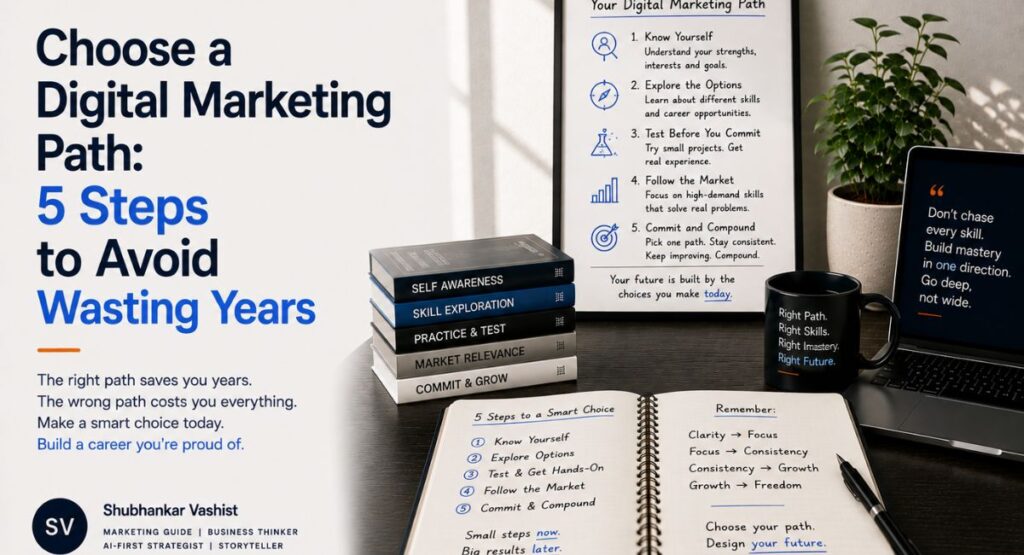
Step 1: Know your strengths.
Are you good with words? Content writing, copywriting, or email marketing might fit. Are you analytical? SEO, paid ads, or analytics could be your zone. Are you visual? Social media content, design, or video marketing might work. Are you a people person? Community management, influencer marketing, or client-facing roles could suit you.
Your past experience matters too. I came from a healthcare background. That didn’t hold me back. It gave me a niche. Healthcare companies need marketers who understand healthcare. Your background is an advantage, not baggage.
Step 2: Know your end goal.
Do you want a job? Then look at what roles companies are hiring for in your target market. Do you want to freelance? Then look at what services small businesses actually pay for. Do you want to build your own thing? Then learn marketing as a growth tool, not a career.
Different goals point to different paths. A job seeker might focus on one specialized skill. A freelancer might need a broader base. A founder might need just enough to drive their own growth. Clarity on this changes everything.
Step 3: Pick one path and commit for 90 days.
This is the step most people skip. They research endlessly, compare endlessly, and never commit. Don’t do that. Pick one path based on your strengths and goals. Then commit to it fully for 90 days.
Ninety days is enough to learn the fundamentals. Enough to build a few real projects. Enough to know if this path feels right or not. But only if you go all in. Half effort produces half answers.
Step 4: Build real proof along the way.
Don’t just learn your chosen skill. Apply it. If you chose SEO, optimize a real website. If you chose content, publish real articles. If you chose ads, run a small campaign with a tiny budget. Proof of work matters more than any certificate. And proof helps you decide if this path is right for you.
Step 5: Evaluate and adjust.
After 90 days, ask yourself. Did I enjoy the work? Was I able to produce results? Do I want to go deeper or try something else? If the answer is yes, go deeper. If the answer is no, you now have real data to guide your next choice. You’re not starting from zero again. You’re starting from experience.
The Career Paths Explained Simply
SEO Specialist. You help websites rank higher in search results. Requires analytical thinking, patience, and long-term focus. Results take time, but they compound. Good for people who like solving puzzles.
Paid Ads Specialist. You manage ad campaigns on platforms like Meta and Google. Requires analytical thinking, comfort with numbers, and quick decision-making. Results are fast. Good for people who like immediate feedback.
Content Writer or Copywriter. You write content that attracts and persuades. Requires strong language skills and empathy for the reader. Good for people who love words and understand human psychology.
Social Media Manager. You manage brand presence on social platforms. Requires creativity, consistency, and community engagement. Good for people who love creating and connecting.
Email Marketer. You build and manage email campaigns and automations. Requires writing skills and strategic thinking. Good for people who like structured communication.
Analytics Specialist. You measure and interpret marketing data. Requires analytical thinking and comfort with tools. Good for people who love numbers and patterns.
Full-Stack Marketer. You combine multiple skills over time. This is where I ended up. Not because I planned it. Because I kept learning and applying. This path takes longer but offers the most flexibility.
Which Path Did I Choose?
I didn’t choose one path at first. I fumbled through several. Website building led to content. Content led to understanding SEO. SEO led to understanding how traffic works. Traffic understanding led to paid ads. Each skill connected to the next.
But the turning point was building my first real website. That forced me to focus. And that focus revealed what I enjoyed and what I was good at.
Looking back, my path made sense. But it wasn’t planned. It emerged from doing. That’s the secret. Clarity comes from action, not analysis.
Checklist for Choosing Your Path
- □ Have you identified your natural strengths, or are you ignoring them?
- □ Do you know your end goal, or are you exploring without direction?
- □ Have you picked one path and committed, or are you still sampling?
- □ Are you building real projects, or just consuming information?
- □ Have you given your chosen path at least 90 days of focused effort?
- □ Are you using your past experience as an advantage, or treating it as baggage?
- □ Do you have proof of work in your chosen path, or just theoretical knowledge?
- □ Are you choosing based on your own strengths, or someone else’s success story?
Things Nobody Tells You About Choosing a Path
You don’t need to choose perfectly. You need to choose something. Most successful marketers I know didn’t plan their path from day one. They started with one skill, got good at it, and expanded from there.
Your first choice won’t be your last choice. Marketing skills overlap. What you learn in one area helps you in others. An SEO specialist who learns copywriting becomes more valuable. A content writer who learns analytics becomes more strategic. Paths are not permanent. They evolve.
The market rewards specialists early and generalists later. Early in your career, go deep on one thing. That’s what gets you hired. Later, broaden your base. That’s what gets you promoted or lets you build your own thing.
Reality Check
You will waste more time deciding than doing. The paralysis of choice is costing you more than the risk of a wrong choice ever could. A wrong choice that leads to action teaches you something. No choice just keeps you stuck.
Common Mistake
People choose the path that looks most glamorous, not the one that fits them. They see an ads specialist talking about big budgets and think that’s for them. They see a content creator with a large audience and want that. But glamour fades. Fit doesn’t. Choose what fits you, not what impresses others.
Key Takeaway
Choosing the right marketing career path isn’t about finding the perfect option. It’s about understanding your strengths, knowing your goals, picking one direction, and committing long enough to build real skill. The path reveals itself through action, not analysis. Start before you feel certain. Certainty comes from doing, not thinking.
Your Next Step Today
Take 30 minutes. Write down your strengths. Write down your end goal. Then pick one marketing path that fits both. Don’t overthink it. Just pick. Now commit to 90 days of focused learning and building in that path. Not 90 days of watching videos. 90 days of producing work. That’s how you stop wasting years and start building a career.
FAQ
Q: What if I choose the wrong path?
A: There is no permanently wrong path. Every marketing skill is useful. Even if you pivot later, what you learned won’t be wasted. The only wrong choice is staying stuck in indecision. Choose, learn, evaluate, adjust. Repeat.
Q: How do I know if a path fits me?
A: You won’t know until you try it. Reading about SEO and doing SEO are different things. Give yourself 90 days of focused effort. That’s enough to know if the work energizes you or drains you. Real experience beats speculation every time.
Q: Can I learn multiple paths at once?
A: Not effectively. When you split your attention, you learn everything slowly and nothing deeply. Master one thing first. Then add others. The marketers who succeed are not the ones who know a little about everything. They’re the ones who know a lot about one thing, then expand.