
You are excited. You just decided to learn digital marketing. You open YouTube. You search “how to learn digital marketing.” You find ten videos. You watch three. Each one recommends different things. One says start with SEO. Another says learn ads first. A third says build a personal brand.
Now you are confused. So you watch more videos. You read more articles. You join more groups. Weeks pass. You have consumed dozens of hours of content. But you haven’t built a single thing.
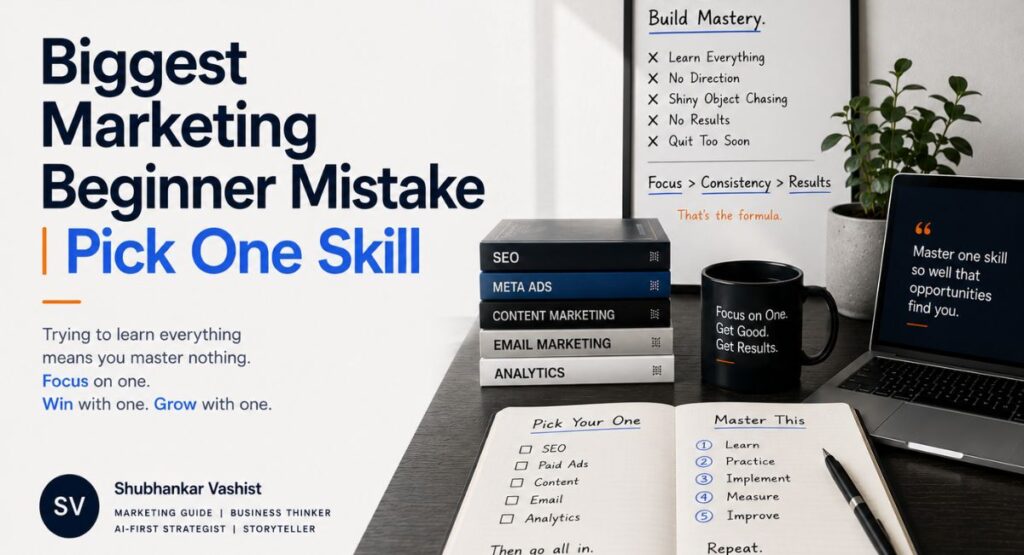
That is the biggest mistake beginners make. They try to learn everything at once. And they end up learning nothing.
I know because I made the exact same mistake. And I see it in almost every beginner I meet.
| What Beginners Do | What Beginners Should Do |
|---|---|
| Watch everything | Pick one thing |
| Jump between topics | Follow a sequence |
| Collect information | Build projects |
| Seek more resources | Apply what they already have |
| Wait until they feel ready | Start before they feel ready |
My Story
When I started learning marketing, I consumed everything. SEO playlists. Google Digital Garage. Udemy courses. Social media tutorials. Webinars. Blog posts. Twitter threads. I was everywhere and nowhere at the same time.
I felt busy. My notes app was overflowing. My browser had fifty tabs open. I could talk about marketing concepts. I knew the jargon. I sounded knowledgeable.
Then someone asked me a simple question. “Can you build a website?”
I couldn’t. All that learning. All those hours. And I couldn’t do the most basic thing.
That was my wake-up call. I stopped trying to learn everything. I picked one skill. Website building. I focused on it for weeks. I built my first website. It was ugly. It was basic. But it worked. And finishing that one project taught me more than all the scattered learning I had done before.
Why Beginners Try to Learn Everything
It comes from fear. Fear of missing out. What if I don’t learn SEO and that’s what gets people hired? What if I skip email marketing and that’s the skill clients want? What if I ignore personal branding and everyone else gets noticed?
So you try to cover everything. A little SEO. A little content. A little ads. A little social media. You become a jack of all trades and master of none. The market doesn’t reward jack of all trades. It rewards people who are excellent at one thing and competent at the rest.
It also comes from confusion. Nobody tells beginners what to learn first. There is no standard curriculum. Every expert has a different opinion. So beginners try to follow everyone and end up following no one.
What Actually Works
Pick one skill.
Not five. Not three. One. SEO. Or content writing. Or Meta ads. Or social media management. Or email marketing. Pick the one that interests you most. Or the one that’s most in demand in your target industry. Just pick one.
I picked website building. Not because it was the best choice. Because it was a choice. And having one focus was better than having ten.
Learn the fundamentals of that skill.
Not advanced strategies. Not growth hacks. Fundamentals. What is SEO? How do search engines work? What makes content rank? What makes an ad convert? Master the basics before you touch anything advanced.
Use free resources first. YouTube has everything you need for the fundamentals. Google offers free certifications. Communities share knowledge openly. You don’t need to spend money to learn the basics.
Build something immediately.
Don’t wait until you finish the course. Don’t wait until you feel ready. As soon as you understand the basics, build something. If you’re learning SEO, optimize a real page. If you’re learning ads, launch a campaign with a tiny budget. If you’re learning content, write and publish a blog post.
My first website was built before I knew what I was doing. I figured it out as I went. That’s the point. You learn by doing, not by preparing to do.
Get feedback.
Show your work to someone who knows more than you. Ask what’s wrong. Ask what to fix. Feedback turns practice into progress. Without feedback, you can practice the wrong things for months and never improve.
Repeat with the next skill.
Once you’re competent at one skill, add another. Then another. In a year, you’ll have real competence across multiple areas. But it starts with one.
The Sequence I Recommend
There is no perfect sequence. But here is what worked for me and what I teach my students now.
Start with marketing fundamentals. Understand the customer. Define the audience. Map the journey. Learn the psychology of why people buy. Without this foundation, every tactic you learn will be hollow.
Then learn AI tools. ChatGPT, Claude, and other AI tools amplify everything else you do. Prompt engineering is a superpower. Learn it early.
Then build something visual. A website. A landing page. Something you can point to and say “I made that.” This builds confidence and creates proof of work.
Then content and distribution. Social media. SEO. Learn to create content that attracts attention and ranks in search results.
Then paid acquisition. Ads. Once you understand organic, paid becomes much easier because you know what messages resonate.
Finally, automation and systems. Email marketing. WhatsApp marketing. Workflow automation. Learn to scale what works.
This is not the only sequence. But it’s a logical one. Each skill builds on the previous one. You’re not jumping randomly. You’re building a stack.
Checklist for Beginners
- □ Have you picked one skill to focus on this month, or are you learning five things?
- □ Are you learning fundamentals, or chasing advanced tactics?
- □ Have you built something with what you learned this week, or just watched videos?
- □ Have you shown your work to someone for feedback, or are you learning in private?
- □ Do you have a clear sequence for what to learn next, or are you deciding daily based on mood?
- □ Are you using free resources before buying courses?
- □ Is your screen time more learning or more doing?
- □ Would you hire yourself based on what you’ve actually built?
Things Nobody Tells You About Learning Marketing
Depth beats breadth in the beginning. One skill, deeply understood, gets you hired. Ten skills, superficially understood, get you ignored. You can always add more skills later. But you need one skill to open the first door.
Your first project will be bad. Accept this. My first website was embarrassing. My first ad campaign lost money. My first SEO attempt didn’t rank. That’s normal. The goal is not perfection. The goal is completion. You can’t improve something you haven’t finished.
Confusion is not a sign that you’re bad at this. Confusion is a sign that you’re trying to learn too much at once. Narrow your focus. The confusion will fade.
Reality Check
If you’ve been “learning marketing” for three months and have nothing to show for it, you’re not learning. You’re consuming. There’s a difference. A portfolio of one real project is worth more than a year of scattered learning. The market doesn’t care what you’ve watched. It cares what you’ve built.
Common Mistake
Beginners often think they need to learn everything before they can start. The opposite is true. Start before you know everything. You’ll learn faster by doing than by watching. The people who succeed are not the ones who prepared the most. They’re the ones who started the earliest.
Key Takeaway
The biggest mistake beginners make is trying to learn everything at once. Pick one skill. Learn the fundamentals. Build something immediately. Get feedback. Repeat. That’s the entire formula. Everything else is just distraction dressed up as learning.
Your Next Step Today
Stop watching videos. Stop reading articles. Pick one marketing skill right now. Just one. Spend 30 minutes learning the fundamentals today. Then spend one hour building something with it. Not tomorrow. Today. Publish whatever you build, no matter how imperfect. Do this for one week. You’ll make more progress than the last month of scattered learning.
FAQ
Q: How do I know which skill to pick first?
A: Pick the one closest to producing a visible result. If you want a job, build a portfolio website. That covers multiple skills at once. If you want clients, learn to run a simple ad campaign. Choose the skill that creates proof of your ability fastest.
Q: What if I pick the wrong skill?
A: There is no wrong skill. Every marketing skill is useful. The only wrong choice is no choice. Picking something and going deep is always better than staying stuck in research mode. You can pivot later.
Q: How long should I focus on one skill before adding another?
A: Until you’ve built something real with it. Not until you feel ready. Until you have proof. A live website. A published article. A completed campaign. A case study. Once you have proof of competence, add the next skill.