
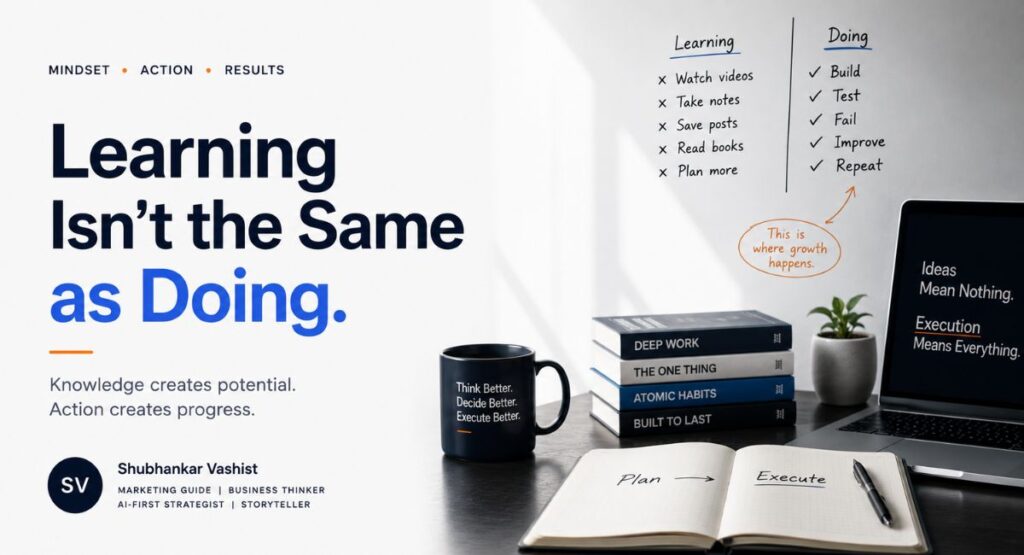
You watch a tutorial. You feel productive. You complete a course. You feel accomplished. You read another thread. You feel informed. But nothing changes. Your career doesn’t move. Your business doesn’t grow. Your skills don’t improve.
This is the trap. Learning feels like progress. But learning without doing is just entertainment dressed up as growth.
I wasted years in this trap. Years. And I didn’t even realize it until I was forced to actually do something.
| What Feels Like Progress | What Actually Is Progress |
|---|---|
| Watching videos | Building something |
| Taking notes | Publishing something |
| Completing courses | Getting feedback |
| Collecting certificates | Creating proof of work |
| Planning to start | Starting before you’re ready |
My Story
When I got laid off in 2020, I had two months with no job and no income. I did what most people do. I started learning. YouTube. Google Digital Garage. Udemy. I consumed everything I could find about websites, SEO, and digital marketing.
For weeks, I felt like I was making progress. My notes were organized. My bookmarks were full. I could talk about marketing concepts. I sounded knowledgeable.
Then someone asked me to actually build a website.
I froze.
All those videos. All those notes. All that theory. And when it was time to actually do the work, I realized I hadn’t learned anything. I had just been collecting information.
That moment changed everything for me. I stopped learning and started building. My first website was basic. Ugly even. But it was real. And the lessons I learned from building that terrible first website were worth more than every video I had watched before it.
Why We Confuse Learning With Doing
Learning gives you a dopamine hit. You understand a new concept. You feel smarter. Your brain rewards you. Doing gives you friction. Things break. You get stuck. You feel stupid. Your brain resists it.
So we default to learning. It’s easier. It’s safer. It feels productive without the discomfort of actual production.
But here is the problem. Nobody pays you for what you know. They pay you for what you can do. Your certificates don’t matter if you can’t build a landing page. Your course completions don’t matter if you can’t run a campaign. Your notes don’t matter if you can’t solve a real problem.
I learned this the hard way. When I was working across multiple roles, nobody asked me what courses I had completed. They asked me to handle purchase, manage customer support, run marketing campaigns. They didn’t care about my learning history. They cared about my ability to execute.
The Three Lies We Tell Ourselves
Lie 1: I’ll start when I’m ready.
You will never feel ready. Ready is a feeling, not a fact. The people who succeed are not the ones who felt ready. They are the ones who started before they felt ready. My first website was built before I knew what I was doing. My first ad campaign was launched before I understood targeting. You don’t need to be ready. You need to start.
Lie 2: I need to learn more first.
More learning is the enemy of action. Every hour you spend learning something new is an hour you didn’t spend applying something old. You probably already know enough to start. You’re just using “learning more” as an excuse to avoid the discomfort of doing.
Lie 3: My first attempt needs to be perfect.
Perfectionism is procrastination in a suit. It looks professional. It sounds reasonable. But it’s just fear dressed up. Your first attempt will be bad. Mine was. Everyone’s is. The goal is not to be perfect on day one. The goal is to be better on day thirty. You can’t get to day thirty without surviving day one.
What Doing Actually Looks Like
Doing is messy.
Things break. You get errors you don’t understand. You Google solutions. You try five things. Four fail. One works. That’s learning. Real learning. The kind that sticks.
Doing is public.
When you learn privately, nobody sees your mistakes. When you do publicly, you risk judgment. But you also get feedback. You get real reactions. You learn what actually works, not what theory says should work.
Doing is iterative.
You don’t build a masterpiece on your first try. You build something small. You see what works. You improve it. You build again. This cycle of build, measure, learn, and rebuild is the only path to mastery.
Doing creates proof.
A portfolio of real projects beats a resume full of courses every single time. Employers want to see what you’ve made. Clients want to see what you’ve done. The market doesn’t care about your learning. It cares about your output.
How I Shifted From Learning To Doing
I made myself a rule. For every hour I spent learning, I had to spend two hours applying. If I watched a video about SEO, I had to optimize a real page. If I learned about ads, I had to launch a real campaign with a tiny budget.
This rule changed everything. It forced me to stop hoarding information and start creating things. The first few attempts were painful. I got stuck constantly. But each time I pushed through the stuckness, I learned more than any course could teach me.
When I started teaching, I applied the same rule. My students don’t just watch sessions. They build websites. They launch campaigns. They create content. Every week has an output. Because I know that the output is where the real learning happens.
Checklist For Moving From Learning To Doing
- □ Have you built something this week, or just consumed something?
- □ Is your portfolio growing, or just your course library?
- □ Have you published anything recently that scared you a little?
- □ Are you measuring progress by hours spent or things created?
- □ Do you have a personal rule for balancing learning and doing?
- □ Have you set a deadline for your next real output?
- □ Are you waiting for perfection, or are you shipping work?
- □ Would you hire yourself based on what you’ve actually built?
Things Nobody Tells You About The Learning Trap
The most dangerous thing about the learning trap is that it’s socially acceptable. Nobody questions you when you say you’re taking a course. Everyone praises self-improvement. But if you spend months “learning” with nothing to show for it, you haven’t improved. You’ve just been busy.
Knowledge without application decays. If you don’t use what you learn within days, your brain discards it. That course you completed last month? If you haven’t applied anything from it, you’ve probably already forgotten most of it.
The market pays for solutions, not knowledge. Nobody hires a marketer because they know the theory of funnels. They hire a marketer because they can build a funnel that converts. The gap between knowing and doing is where most careers die.
Reality Check
Look at your last three months. How many things have you built? How many projects have you shipped? How many real attempts have you made? If the answer is zero, you haven’t been learning. You’ve been hiding. There is no gentle way to say this. Learning without doing is a comfortable form of failure.
Common Mistake
People think they need more information before they can act. So they take another course. Read another book. Watch another video. But the information gap is rarely the real problem. The action gap is. You already know enough to start. You just don’t want to feel the discomfort of being a beginner. That discomfort is the price of growth.
Key Takeaway
Learning and doing are not the same thing. Learning is passive. Doing is active. Learning is comfortable. Doing is uncomfortable. Learning creates knowledge. Doing creates proof. If your goal is to grow your career or business, only one of these matters. Start doing before you feel ready. That’s how you actually learn.
Your Next Step Today
Pick one thing you’ve been “learning about” but haven’t done yet. A landing page. A social media post. A small ad campaign. A website. Give yourself two hours. Not two weeks. Two hours. Build the simplest version possible. Publish it. Send it to one person for feedback. Do not wait until you feel ready. Ready doesn’t exist.
FAQ
Q: How do I know if I’m in the learning trap?
A: Look at your output from the last month. How many real things have you created, published, or launched? If you have consumed more than you have produced, you are in the trap. The ratio should be at least equal. Ideally, more doing than learning.
Q: What if I try something and it fails publicly?
A: Good. Nobody remembers a stranger’s failed post or broken website. The internet moves too fast. But the lessons you learn from that public attempt stay with you forever. The fear of public failure is always worse than the reality of it.
Q: How do I balance learning new skills with applying what I know?
A: Use the two-to-one rule. For every hour of learning, spend two hours applying. If you watch a one-hour tutorial, spend the next two hours building something with that knowledge. This forces you to prioritize learning that actually leads to action.