
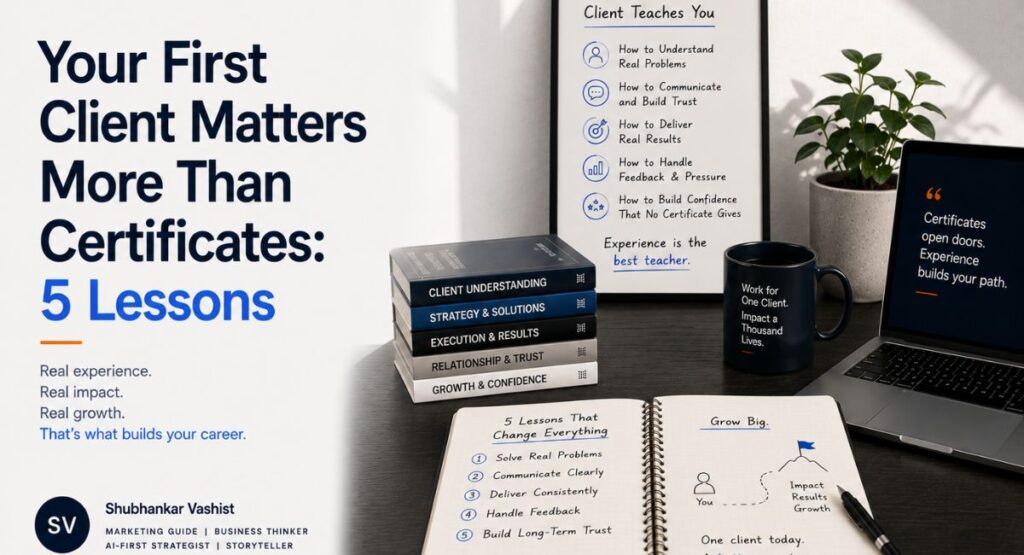
You just completed a certification. You feel proud. You add it to your LinkedIn profile. You update your resume. You start applying for jobs and pitching clients. Surely now they’ll take you seriously.
But they don’t. Employers ask for experience. Clients ask for proof. Nobody asks about your certificate. Nobody cares.
This is the brutal truth about marketing. Certificates don’t prove you can do the work. Clients do.
I learned this the hard way. And once I understood it, everything changed.
| What Beginners Chase | What Actually Matters |
|---|---|
| Certificates | Real projects |
| Course completions | Client results |
| Theoretical knowledge | Practical proof |
| Credentials | Portfolio |
| Grades | Testimonials |
My Story
When I started learning marketing, I collected certifications. Google Digital Garage. Udemy completions. Various course certificates. I thought each one made me more employable. I was wrong.
Nobody asked about my certificates. Not one employer. Not one client. They asked different questions. “What have you built?” “Who have you worked with?” “What results have you delivered?”
I had no answers. I had certificates. But I had no proof.
Then I got my first client. A small Ayurveda brand needed a website. The budget was tiny. The project was simple. But it was real. I wasn’t building something for practice. I was building something for a business that would actually use it.
That project taught me more than every certification combined. I dealt with real requirements, real deadlines, real feedback, and real consequences. When it was done, I had something no certificate could give me. A real project. A real client. Real proof.
That proof opened more doors than any credential ever did.
Why Certificates Don’t Matter as Much as You Think
Certificates prove you watched something. They prove you passed a test. They prove you can remember information long enough to answer questions correctly.
They don’t prove you can execute. They don’t prove you can handle a real client who changes their mind three times. They don’t prove you can troubleshoot when things break. They don’t prove you can deliver results under pressure.
Clients don’t hire certificates. They hire confidence. They hire proof. They hire someone who can point to something real and say, “I did that. I can do it for you too.”
A certificate says, “I studied this.” A portfolio says, “I did this.” Only one of those gets you hired.
What Your First Client Actually Teaches You
How to communicate.
Courses don’t teach you how to handle a client call. How to understand what they really need when they can’t articulate it clearly. How to manage expectations. How to say no politely. How to deliver bad news. These are skills you only learn through real interactions.
How to solve real problems.
Practice exercises have clean answers. Real projects are messy. Things break. Platforms change. Clients request things you don’t know how to do. You figure it out because you have to. That pressure teaches you more than any simulated exercise ever could.
How to manage your own psychology.
Your first client will make you nervous. You’ll doubt yourself. You’ll worry about failing. You’ll wonder if you’re good enough. Pushing through that fear and delivering anyway, that’s what builds real confidence. Not a certificate. Completed work.
How to get paid.
Courses don’t teach you how to price your work. How to send an invoice. How to follow up when payment is late. How to negotiate. These are business skills that matter as much as marketing skills.
How to get referrals.
One happy client leads to another. My second client came from a referral from my first. My third from my second. This chain reaction doesn’t start with a certificate. It starts with a client who trusts you.
How to Get Your First Client
Start small.
Your first client doesn’t need to be a big brand. It can be a friend’s business. A local shop. A freelancer who needs help. A small project with a small budget. The goal is not money. The goal is proof.
Offer a focused service.
Don’t pitch “digital marketing.” That’s too broad. Pitch something specific. “I’ll build your website.” “I’ll run your Instagram for a month.” “I’ll write five SEO-optimized blog posts.” Specific gets hired. Generic gets ignored.
Use your existing network.
Your first client is probably someone you already know. A former colleague. A friend who runs a business. Someone from your community. Don’t be shy about telling people what you’re learning and what you can offer.
Do the first project at a lower rate.
Your first client is taking a chance on you. Acknowledge that. Offer a fair price that reflects your experience level. The testimonial and portfolio piece are worth more than the money at this stage.
Overdeliver.
Your first client is not just a client. They’re your marketing. Do excellent work. Be responsive. Be professional. Make them so happy they tell others about you. One delighted client is worth more than any advertising.
Checklist for Getting Your First Client
- □ Do you have a specific service you can offer, or are you pitching something vague?
- □ Have you told your existing network what you do and that you’re looking for projects?
- □ Are you willing to start small and build from there?
- □ Do you have a way to show proof of your work, even if it’s practice projects?
- □ Are you focusing on client results or just collecting more credentials?
- □ Have you set realistic expectations for your first project?
- □ Are you prepared to overdeliver and earn a referral?
- □ Is your focus on what you’ll learn from the experience, not just what you’ll earn?
Things Nobody Tells You About Your First Client
Your first client doesn’t care about your education. They care about their problem. If you can solve it, they’ll hire you. If you can’t, no certificate will convince them.
The imposter syndrome will be loud before your first client call. You’ll feel like a fraud. You’ll want to cancel. Do it anyway. Everyone feels this. The feeling doesn’t go away until you have proof that you can deliver. The only way to get that proof is to do the work.
Your first client might not be your ideal client. That’s fine. The goal is not perfection. The goal is momentum. Once you have one client, getting the second is easier. Once you have five, getting the tenth is easier still. But none of that happens without the first one.
Reality Check
A year from now, nobody will care about your certificates. They’ll care about your work. They’ll look at your portfolio. They’ll read your case studies. They’ll talk to your past clients. Your certificates will be buried somewhere in a LinkedIn profile nobody reads. Your client work will be the only thing that speaks.
Common Mistake
Beginners think they need more credentials before they can get clients. So they take another course. Earn another certificate. Delay another month. This is fear pretending to be preparation. You are ready enough. Start before you feel ready. The first client will teach you what no course can.
Key Takeaway
Certificates prove you studied. Clients prove you can deliver. One client is worth more than ten certificates. Stop chasing credentials. Start chasing real projects. Your first client will be scary, imperfect, and absolutely transformative. It was for me. It will be for you.
Your Next Step Today
Stop studying. Start reaching out. Identify five people in your network who might need help with something you can do. Send them a message today. Not a pitch. A genuine offer to help. “I’m building my portfolio and I’d love to help you with your website content. No charge for the first piece. I just want to create something real.” Someone will say yes. That yes changes everything.
FAQ
Q: What if I can’t find a paying client?
A: Start with free work. Offer to help a friend, a local business, or a nonprofit. The goal is to create a real project with real impact. A free project that delivers results is more valuable than no project at all. Use it to build your portfolio and get a testimonial. Paid work follows.
Q: How do I know if I’m ready for clients?
A: You’ll never feel ready. The question isn’t “Am I ready?” It’s “Can I solve this specific problem for this specific person?” If the answer is maybe, you’re ready enough. The first client helps you figure out the rest.
Q: What if I mess up the first project?
A: You might. I made mistakes on my first project too. Be honest with your client. Fix the problem. Learn from it. One imperfect project with a happy client is worth more than zero projects. The only true failure is not starting at all.